
Aerospace Engineering
2025 · Paper 1
Take it one question at a time. Try an answer, then check your understanding.
Complete GATE AE 2025 Paper 1 overview, original pages and practice · Timed previous-paper practice
Questions 52–54 of 65. Imported answers require review unless explicitly marked reviewed.
Question 52
Open questionAENAT2 marksNeeds review
A jet-powered airplane is steadily climbing at a rate of 10 m/s. The air density is 0.8 kg/m
, and the thrust force is aligned with the flight path. Using the information provided in the table below, the airplane’s thrust to weight ratio is
(rounded off to one decimal place).|Airplane speed|80 m/s|
|---|---|
|Lift coefficient,
|0.8|
|Aspect ratio|6|
|Oswald efficiency factor|0.8|
|Zero-lift drag coefficient|0.02|Log in to check the answer
You can attempt this question now. Sign in to view the answer key, explanations and discussion.Log in to check answerQuestion 53
Open questionAENAT2 marksNeeds review
F and G denote two points on a spacecraft’s orbit around a planet, as indicated in the figure. O is the center of the planet, P is the periapsis, and the angles are as indicated in the figure. If OF = 8000 km, OG = 10000 km,
deg, and
deg, the eccentricity of the spacecraft’s orbit is
(rounded off to two decimal places). 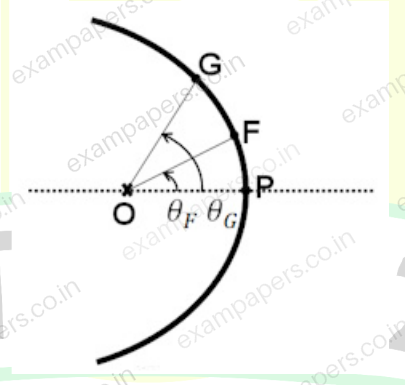
Log in to check the answer
You can attempt this question now. Sign in to view the answer key, explanations and discussion.Log in to check answerQuestion 54
Open questionAENAT2 marksNeeds review
While taking off, the net external force acting on an airplane during the ground roll segment can be assumed to be constant. The airplane starts from rest.
and
are the ground roll distance and the lift-off speed, respectively.
(
) denotes the airplane speed at
. Neglecting changes in the airplane mass during the ground roll segment, the value of
is
(rounded off to two decimal places).Log in to check the answer
You can attempt this question now. Sign in to view the answer key, explanations and discussion.Log in to check answer