
Chemical Engineering
2019 · Paper 1
Take it one question at a time. Try an answer, then check your understanding.
Complete GATE CH 2019 Paper 1 overview, original pages and practice · Timed previous-paper practice
Questions 55–57 of 65. Imported answers require review unless explicitly marked reviewed.
Question 45
Open questionCHNAT2 marksNeeds review
The elementary, irreversible, liquid-phase, parallel reactions, 2A → D and 2A → U, take place in an isothermal non-ideal reactor. The C-curve measured in a tracer experiment is shown in the figure, where
is the concentration of the tracer in g/m³ at the reactor exit at time
(in min).
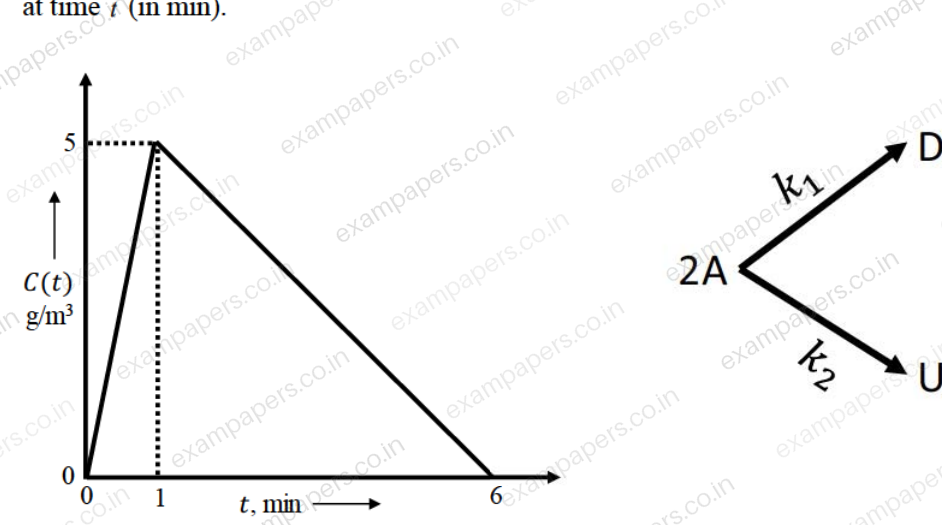
The rate constants are
Liter/(mol min) and
Liter/(mol min). Pure A is fed to the reactor at a concentration of 2 mol/Liter. Using the segregated model, the percentage conversion in the reactor is __________ (rounded off to the nearest integer).Log in to check the answer
You can attempt this question now. Sign in to view the answer key, explanations and discussion.Log in to check answerQuestion 46
Open questionCHNAT2 marksNeeds review
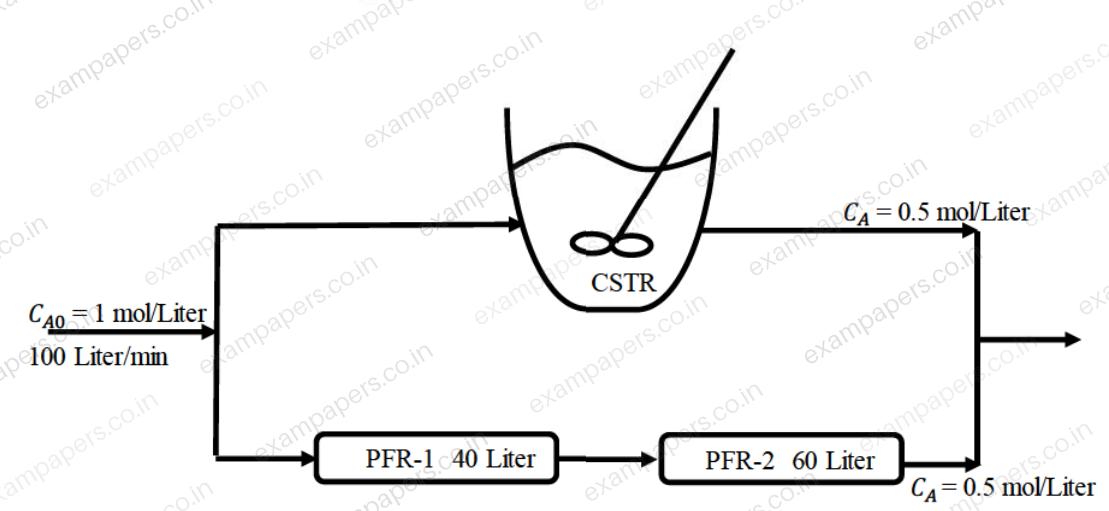
A first-order irreversible liquid phase reaction A → B (
min⁻¹) is carried out under isothermal, steady state conditions in the following reactor arrangement comprising an ideal CSTR (Continous-Stirred Tank Reactor) and two ideal PFRs (Plug Flow Reactors). From the information in the figure, the volume of the CSTR (in Liters) is __________ (rounded off to the nearest integer).
Log in to check the answer
You can attempt this question now. Sign in to view the answer key, explanations and discussion.Log in to check answerQuestion 47
Open questionCHNAT2 marksNeeds review
The elementary liquid-phase irreversible reactions
take place in an isothermal ideal CSTR (Continuous-Stirred Tank Reactor). Pure A is fed to the reactor at a concentration of 2 mol/Liter. For the residence time that maximizes the exit concentration of B, the percentage yield of B, defined as
, is __________ (rounded off to the nearest integer).Log in to check the answer
You can attempt this question now. Sign in to view the answer key, explanations and discussion.Log in to check answer