
Chemical Engineering
2020 · Paper 1
Take it one question at a time. Try an answer, then check your understanding.
Complete GATE CH 2020 Paper 1 overview, original pages and practice · Timed previous-paper practice
Questions 49–51 of 65. Imported answers require review unless explicitly marked reviewed.
Question 39
Open questionCHMCQ2 marksNeeds review
A pure gas obeys the equation of state given by
where
is the pressure,
is the absolute temperature,
is the molar volume of the gas,
is the universal gas constant, and
is a parameter independent of
and
. The residual molar Gibbs energy,
, of the gas is given by the relation
where
is the compressibility factor and the integral is evaluated at constant
. If the value of
is
, the residual molar enthalpy (in J mol
) of the gas at 100 kPa and 300 K isYour answerChoose one option.
Log in to check the answer
You can attempt this question now. Sign in to view the answer key, explanations and discussion.Log in to check answerQuestion 40
Open questionCHMCQ2 marksNeeds review
Consider one mole of an ideal gas in a closed system. It undergoes a change in state from L to N through two different non-isothermal processes, as shown in the P-V diagram (where
is the pressure and
is the molar volume of the gas). Process I is carried out in a single step, namely LN, whereas process II is carried out in two steps, namely LM and MN. All the steps are reversible.The net heat flowing into the system for process I is
, and that for process II is
. The value of
(in J) is 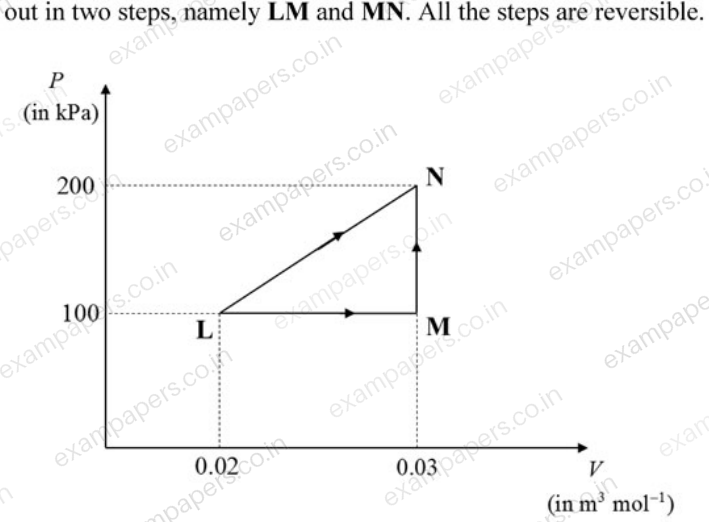
Your answerChoose one option.
Log in to check the answer
You can attempt this question now. Sign in to view the answer key, explanations and discussion.Log in to check answerQuestion 41
Open questionCHNAT2 marksNeeds review
A fluid is heated from 40 °C to 60 °C in a countercurrent, double pipe heat exchanger. Hot fluid enters at 100 °C and exits at 70 °C. The log mean temperature difference, i.e. LMTD (in °C), is __________ (round off to 2 decimal places).
Log in to check the answer
You can attempt this question now. Sign in to view the answer key, explanations and discussion.Log in to check answer