
Chemical Engineering
2020 · Paper 1
Take it one question at a time. Try an answer, then check your understanding.
Complete GATE CH 2020 Paper 1 overview, original pages and practice · Timed previous-paper practice
Questions 55–57 of 65. Imported answers require review unless explicitly marked reviewed.
Question 45
Open questionCHNAT2 marksNeeds review
An aqueous suspension at 60 °C is fed to the first effect of a double effect forward feed evaporator with a mass flow rate of 1.25 kg s
. The sum of the rates of water evaporated from the first and second effects is 1.0 kg s
. Temperatures of the exit streams from the first and the second effects are 100 °C, and 60 °C, respectively. Consider the specific heat of the aqueous suspension, and the latent heat of phase change for water to be 4 kJ kg
K
and 2200 kJ kg
, respectively, over this temperature range. The steam economy (in kg per kg) is ________ (round off to 2 decimal places).Log in to check the answer
You can attempt this question now. Sign in to view the answer key, explanations and discussion.Log in to check answerQuestion 46
Open questionCHNAT2 marksNeeds review
A vertically held packed bed has a height of 1 m, and a void fraction of 0.1, when there is no flow through the bed. The incipient (minimum) fluidization is set in by injection of a fluid of density 1 kg m
. The particle density (
) of the solids is 3000 kg m
. Acceleration due to gravity is 9.81 m s
. The pressure drop (in Pa) across the height of the bed is ________ (round off to nearest integer).Log in to check the answer
You can attempt this question now. Sign in to view the answer key, explanations and discussion.Log in to check answerQuestion 47
Open questionCHNAT2 marksNeeds review
Two ideal cross-current stages operate to extract P from a feed containing P and Q, as shown below.
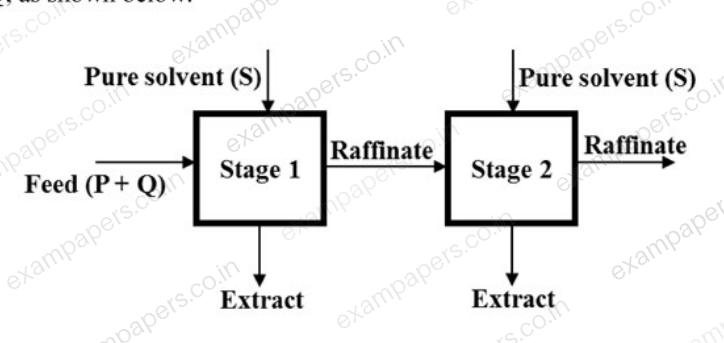
The mass flow rates of P and Q fed to Stage 1 are 1,000 kg h
and 10,000 kg h
, respectively. Pure solvent (S) is injected at mass flow rates of 5,000 kg h
and 15,000 kg h
to Stages 1 and 2, respectively. The components Q and S are immiscible. The equilibrium relation is given by
, where
is the mass of P per unit mass of Q in the raffinate, and
is the mass of P per unit mass of S in the extract, which is in equilibrium with the raffinate. The mass flow rate of P (in kg h
) in the raffinate from Stage 2 is ________ (round off to nearest integer).Log in to check the answer
You can attempt this question now. Sign in to view the answer key, explanations and discussion.Log in to check answer