
Chemical Engineering
2022 · Paper 1
Take it one question at a time. Try an answer, then check your understanding.
Complete GATE CH 2022 Paper 1 overview, original pages and practice · Timed previous-paper practice
Questions 37–39 of 65. Imported answers require review unless explicitly marked reviewed.
Question 37
Open questionCHMCQ2 marksNeeds review
moles of an ideal gas undergo a two-step process as shown in the figure. Let
,
and
denote the pressure, volume and temperature of the gas, respectively. The gas, initially at state-1 (
), undergoes an isochoric (constant volume) process to reach state-A, and then undergoes an isobaric (constant pressure) expansion to reach state-2 (
). For an ideal gas,
, where
and
are the heat capacities at constant pressure and constant volume, respectively, and are assumed to be temperature independent. The heat gained by the gas in the two-step process is given by 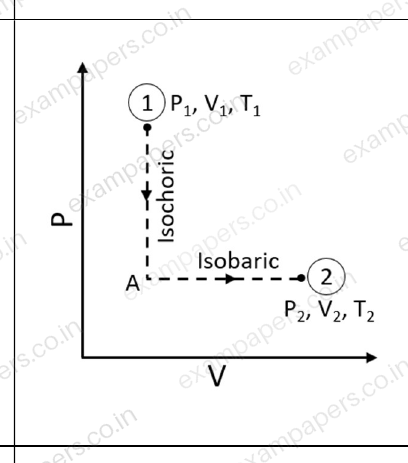
Your answerChoose one option.
Log in to check the answer
You can attempt this question now. Sign in to view the answer key, explanations and discussion.Log in to check answerQuestion 38
Open questionCHMCQ2 marksNeeds review
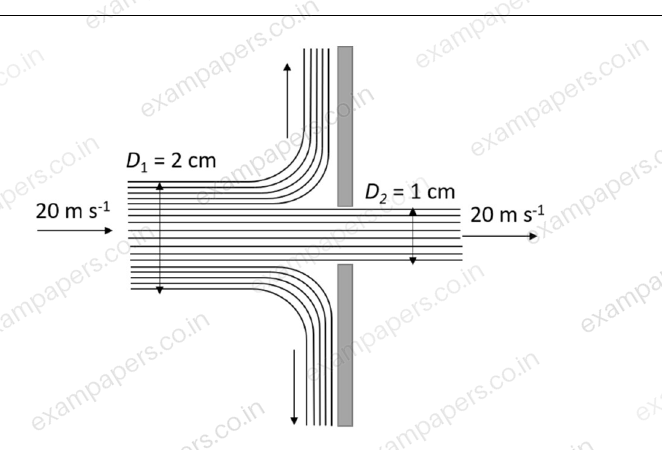
A horizontal cylindrical water jet of diameter
cm strikes a vertical solid plate with a hole of diameter
cm, as shown in the figure. A part of the jet passes through the hole and the rest is deflected along the plate. The density of water is 100 kg m
. If the speed of the jet is 20 m s
, the magnitude of the horizontal force, in N, required to hold the plate stationary is
Your answerChoose one option.
Log in to check the answer
You can attempt this question now. Sign in to view the answer key, explanations and discussion.Log in to check answerQuestion 39
Open questionCHMCQ2 marksNeeds review
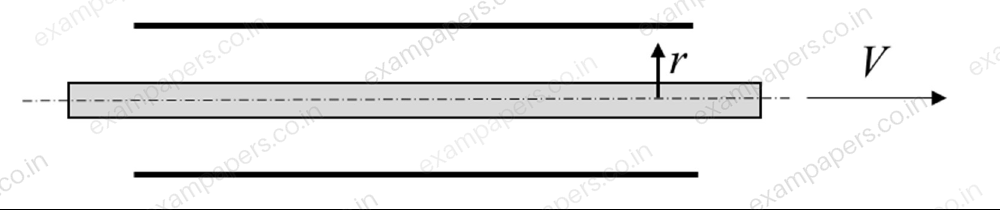
Consider a horizontal rod of radius
(
) in a stationary pipe of radius
. The rod is pulled coaxially at a constant velocity
as shown in the figure. The annular region is filled with a Newtonian incompressible fluid of viscosity
. The steady state fully developed axial velocity profile in the fluid is given by
, where
is the radial coordinate. Ignoring end effects, the magnitude of the pulling force per unit rod length is
Your answerChoose one option.
Log in to check the answer
You can attempt this question now. Sign in to view the answer key, explanations and discussion.Log in to check answer