
Electrical Engineering
2024 · Paper 1
Take it one question at a time. Try an answer, then check your understanding.
Complete GATE EE 2024 Paper 1 overview, original pages and practice · Timed previous-paper practice
Questions 55–57 of 65. Imported answers require review unless explicitly marked reviewed.
Question 55
Open questionEENAT2 marksNeeds review
A 5 kW, 220 V DC shunt motor has 0.5
armature resistance including brushes. The motor draws a no-load current of 3 A. The field current is constant at 1 A. Assuming that the core and rotational losses are constant and independent of the load, the current (in amperes) drawn by the motor while delivering the rated load, for the best possible efficiency, is ________ (rounded off to 2 decimal places).Log in to check the answer
You can attempt this question now. Sign in to view the answer key, explanations and discussion.Log in to check answerQuestion 56
Open questionEENAT2 marksNeeds review
The single line diagram of a lossless system is shown in the figure. The system is operating in steady-state at a stable equilibrium point with the power output of the generator being
, where
is the load angle and the mechanical power input is
. A fault occurs on line 2 such that the power output of the generator is less than
during the fault. After the fault is cleared by opening line 2, the power output of the generator is
. If the critical fault clearing angle is
radians, the accelerating area on the power angle curve is _____ times
(rounded off to 2 decimal places). 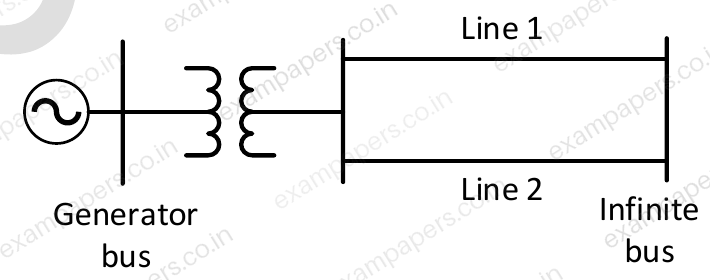
Log in to check the answer
You can attempt this question now. Sign in to view the answer key, explanations and discussion.Log in to check answerQuestion 57
Open questionEENAT2 marksNeeds review
Consider the closed-loop system shown in the figure with
The root locus for the closed-loop system is to be drawn for
. The angle of departure (between
and
) of the root locus branch drawn from the pole
, in degrees, is _________________ (rounded off to the nearest integer). 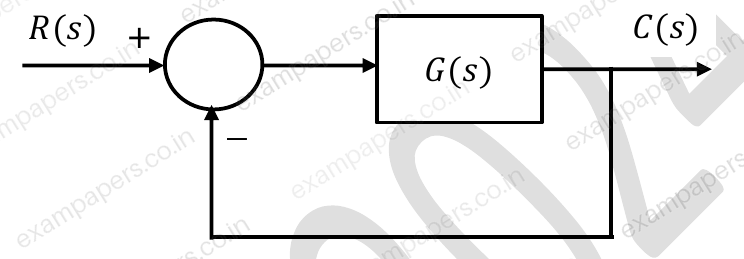
Log in to check the answer
You can attempt this question now. Sign in to view the answer key, explanations and discussion.Log in to check answer