
Mechanical Engineering
2019 · Paper 1
Take it one question at a time. Try an answer, then check your understanding.
Complete GATE ME 2019 Paper 1 overview, original pages and practice · Timed previous-paper practice
Questions 43–45 of 65. Imported answers require review unless explicitly marked reviewed.
Question 33
Open questionMEMCQ2 marksNeeds review
A gas is heated in a duct as it flows over a resistance heater. Consider a 101 kW electric heating system. The gas enters the heating section of the duct at 100 kPa and 27 °C with a volume flow rate of 15 m³/s. If heat is lost from the gas in the duct to the surroundings at a rate of 51 kW, the exit temperature of the gas is
(Assume constant pressure, ideal gas, negligible change in kinetic and potential energies and constant specific heat,
kJ/kg·K;
kJ/kg·K.)Your answerChoose one option.
Log in to check the answer
You can attempt this question now. Sign in to view the answer key, explanations and discussion.Log in to check answerQuestion 34
Open questionMEMCQ2 marksNeeds review
A plane-strain compression (forging) of a block is shown in the figure. The strain in the z-direction is zero. The yield strength (
) in uniaxial tension/compression of the material of the block is 300 MPa and it follows the Tresca (maximum shear stress) criterion. Assume that the entire block has started yielding. At a point where
MPa (compressive) and
, the stress component
is
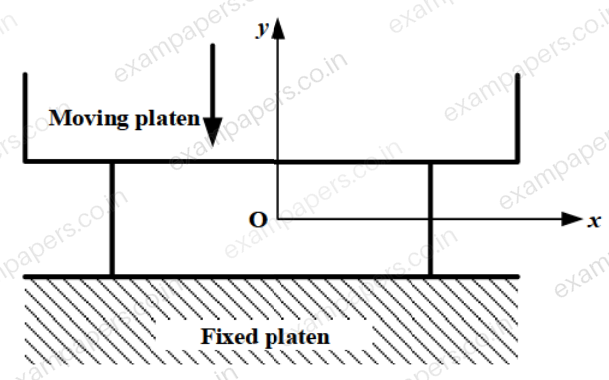
Your answerChoose one option.
Log in to check the answer
You can attempt this question now. Sign in to view the answer key, explanations and discussion.Log in to check answerQuestion 35
Open questionMEMCQ2 marksNeeds review
In orthogonal turning of a cylindrical tube of wall thickness 5 mm, the axial and the tangential cutting forces were measured as 1259 N and 1601 N, respectively. The measured chip thickness after machining was found to be 0.3 mm. The rake angle was 10° and the axial feed was 100 mm/min. The rotational speed of the spindle was 1000 rpm. Assuming the material to be perfectly plastic and Merchant’s first solution, the shear strength of the material is closest to
Your answerChoose one option.
Log in to check the answer
You can attempt this question now. Sign in to view the answer key, explanations and discussion.Log in to check answer