
Mechanical Engineering
2026 · Paper 1
Take it one question at a time. Try an answer, then check your understanding.
Complete GATE ME 2026 Paper 1 overview, original pages and practice · Timed previous-paper practice
Questions 55–57 of 65. Imported answers require review unless explicitly marked reviewed.
Question 55
Open questionMENAT2 marksNeeds review
Convective heat transfer coefficients for Fluid 1 and Fluid 2 in a heat exchanger, as shown in the figure below, are 50 W/(m²K) and 80 W/(m²K), respectively. The inner tube is made of a material which has a thermal conductivity 386 W/(m K) for the given range of temperatures in the heat exchanger. The length of the heat exchanging surface, the inside radius of the inner tube, and thickness of the inner tube are 1 m, 10 mm, and 1 mm, respectively. Considering no heat exchange between the outer tube and the surrounding, the heat transfer rate for the heat exchanger is ______ W (rounded off to 1 decimal place).
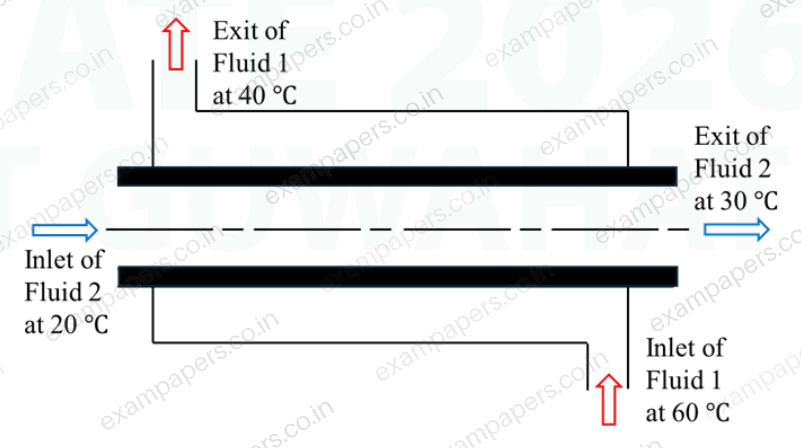
Log in to check the answer
You can attempt this question now. Sign in to view the answer key, explanations and discussion.Log in to check answerQuestion 56
Open questionMENAT2 marksNeeds review
A liquid comes out of the reactor of a chemical plant at 250 °C temperature with a flow rate of 100 LPM. The ambient temperature is 25 °C. Density and specific heat of the liquid remain constant at 1000 kg/m³ and 4.18 kJ/kg K, respectively, for the given range of temperature. The rate of energy associated with the hot liquid stream at the exit of the plant is ______ kW (rounded off to 2 decimal places).
Log in to check the answer
You can attempt this question now. Sign in to view the answer key, explanations and discussion.Log in to check answerQuestion 57
Open questionMENAT2 marksNeeds review
A rigid closed vertical cylindrical vessel of 15 cm diameter contains 5 kg water at 80 °C with 10% quality. The water is heated till its temperature reaches 130 °C. Considering only a horizontal separated interface between liquid and vapor, the dip in the liquid level after the heating process is ______ cm (rounded off to 2 decimal places).
Properties of water at various saturation temperatures are given in the table below.
Temperature | Specific volume | | Specific internal energy | |
|---|---|---|---|---|
(°C) | (m³/kg) | (m³/kg) | (kJ/kg) | (kJ/kg) |
80 | 0.001029 | 3.4053 | 334.97 | 2481.60 |
130 | 0.001070 | 0.6680 | 546.10 | 2539.50 |
,
, and
are temperature, specific volume, and specific internal energy, respectively. Subscripts
and
represent saturated liquid and saturated vapor, respectively.Log in to check the answer
You can attempt this question now. Sign in to view the answer key, explanations and discussion.Log in to check answer