
Architecture and Planning
GATE AR topic:building-construction-and-structural-systems PYQs
Build your understanding with focused practice from past exam papers.
Questions 31–40 of 94. Imported answers require independent review unless marked reviewed.
Question 65
Open questionAR-B1NAT2 marksNeeds review
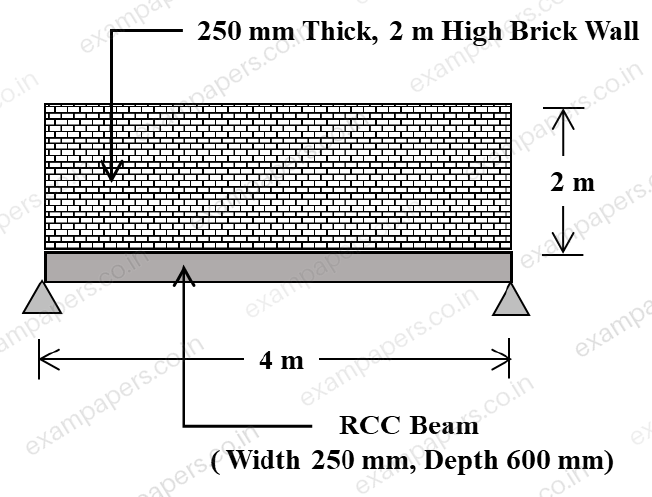
A simply supported RCC beam of span 4 m is supporting a brick wall over its entire span. The brick wall is 250 mm thick and 2 m high. The RCC beam has a depth of 600 mm and width of 250 mm. The density of brick masonry and RCC can be assumed as 18 KN/m^3 and 25 KN/m^3 respectively. Considering the load of the wall and self-weight of the RCC beam, the maximum bending moment in the beam (in KN-m) will be ______ [round off to two decimal places].
Log in to check the answer
You can attempt this question now. Sign in to view the answer key, explanations and discussion.Log in to check answerQuestion 14
Open questionARMCQ1 markNeeds review
The main cable of a suspension bridge supports the deck with hangers. These hangers are equidistant along the length of the bridge and represent a uniform distributed load. Assuming the cable to be weightless as compared to the applied loading, the best approximation of the shape that the cable takes for this loading is a ____________.
Your answerChoose one option.
Log in to check the answer
You can attempt this question now. Sign in to view the answer key, explanations and discussion.Log in to check answerQuestion 23
Open questionARNAT1 markNeeds review
For a masonry section, the line of action of force shifts to incorporate the effects of lateral forces and induced moments. Consider a masonry section of width 600 mm. Assuming a zero tensile stress capacity and a linear stress-strain response for the entire domain of loading, the minimum value of eccentricity at which the section will crack (in mm, rounded off to one decimal place) is __________.
Log in to check the answer
You can attempt this question now. Sign in to view the answer key, explanations and discussion.Log in to check answerQuestion 47
Open questionARNAT2 marksNeeds review
A 230 mm thick brick wall of 10 m length and 3 m height is built using a Flemish bond. The size of the bricks used is 230 mm x 112.5 mm x 70 mm. Assuming a mortar thickness of 5 mm, the number of bricks required (in integer) is __________.
Log in to check the answer
You can attempt this question now. Sign in to view the answer key, explanations and discussion.Log in to check answerQuestion 48
Open questionARNAT2 marksNeeds review
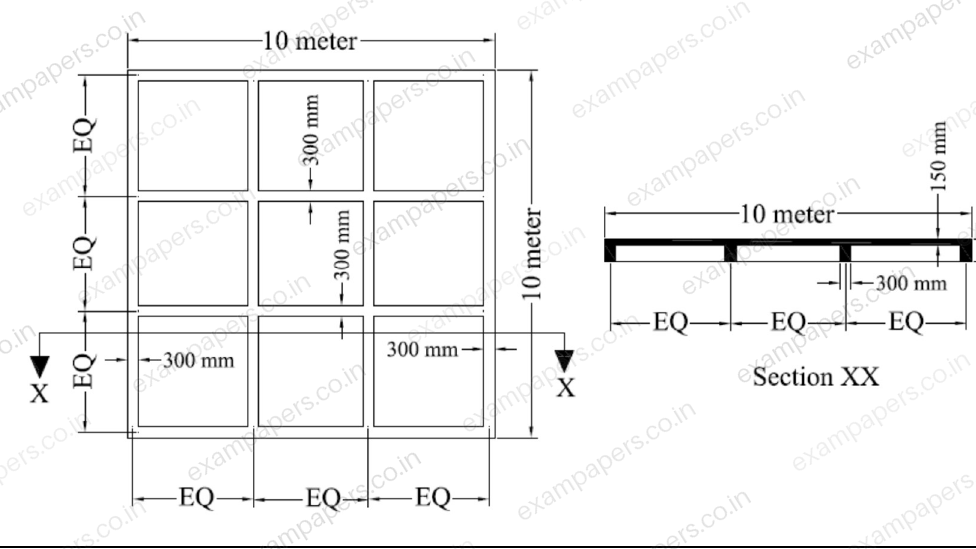
The reflected ceiling plan and section of a reinforced cement concrete roof are shown in the following figure. All the beams are 300 mm wide, 600 mm deep (including 150 mm slab depth) and are placed center to center. Assuming 1% of concrete volume is occupied by reinforcement bars, the volume of concrete (in cubic meters, rounded off to two decimal places) is __________.
Log in to check the answer
You can attempt this question now. Sign in to view the answer key, explanations and discussion.Log in to check answerQuestion 50
Open questionARMCQ1 markNeeds review
Which of the following process is used for surface treatment of metals?
Your answerChoose one option.
Log in to check the answer
You can attempt this question now. Sign in to view the answer key, explanations and discussion.Log in to check answerQuestion 52
Open questionARMCQ1 markNeeds review
An Ultrasonic Pulse Velocity (UPV) test was done on a hardened concrete element using a direct transmission method as per IS 516 (Part 5/Section 1): 2018. The distance between the transducer and receiver was 600 mm. The time taken for the induced wave to travel this distance is measured as 0.18 milliseconds. Based on the following Table, the concrete quality grading is __________.
Velocity (km/s) – cross probing | Concrete quality grading |
|---|---|
Above 4.4 | Excellent |
3.75 – 4.4 | Good |
3.0 – 3.75 | Doubtful |
Less than 3.0 | Poor |
Your answerChoose one option.
Log in to check the answer
You can attempt this question now. Sign in to view the answer key, explanations and discussion.Log in to check answerQuestion 54
Open questionARMSQ1 markNeeds review
If Aluminium : Anodisation :: Glazing : X, which of the following choices present X?
Your answerSelect all correct options. You can choose more than one.
Log in to check the answer
You can attempt this question now. Sign in to view the answer key, explanations and discussion.Log in to check answerQuestion 56
Open questionARNAT1 markNeeds review
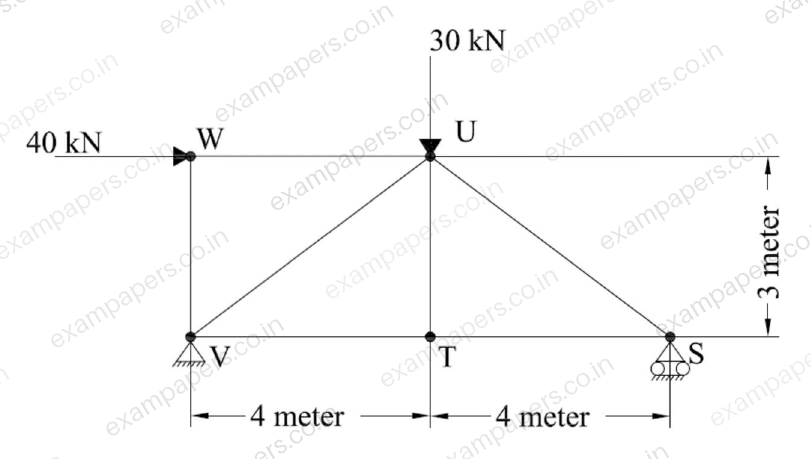
A hypothetical truss comprising of weightless members is shown in the following Figure. Assuming tension to be positive and compression to be negative, the value of force in member TU (in kN, rounded off to one decimal place) is __________.
Log in to check the answer
You can attempt this question now. Sign in to view the answer key, explanations and discussion.Log in to check answerQuestion 59
Open questionARMCQ2 marksNeeds review
Match the structural joining systems in Group I with the corresponding materials for which they are commonly used in Group II.
Group I | | Group II | |
|---|---|---|---|
(P) | Welding | (1) | Glass |
(Q) | Spider Connector | (2) | Plastic |
(R) | Mortise and Tenon | (3) | Brick |
(S) | Mortar | (4) | Steel |
| | (5) | Timber |
Your answerChoose one option.
Log in to check the answer
You can attempt this question now. Sign in to view the answer key, explanations and discussion.Log in to check answer