
Biotechnology
GATE BT topic:recombinant-dna-technology PYQs
Build your understanding with focused practice from past exam papers.
How to practice topic:recombinant-dna-technology
Attempt a question, record the concept and assumptions, then check the available answer. Rework mistakes after revising the relevant concepts. Topic tags can overlap; review the question context.
Questions 1–10 of 10. Imported answers require independent review unless marked reviewed.
Question 45
Open questionBTMSQ2 marksNeeds review
Which of the following vector(s) is(are) used to clone a DNA fragment of size 220 kb?
Your answerSelect all correct options. You can choose more than one.
Log in to check the answer
You can attempt this question now. Sign in to view the answer key, explanations and discussion.Log in to check answerQuestion 25
Open questionBTMCQ1 markNeeds review
The recognition sequences of four Type-II restriction enzymes (RE) are given below. The symbol (↓) indicates the cleavage site. Identify the RE that generates sticky ends.
Your answerChoose one option.
Log in to check the answer
You can attempt this question now. Sign in to view the answer key, explanations and discussion.Log in to check answerQuestion 64
Open questionBTNAT2 marksNeeds review
A circular plasmid has three different but unique restriction sites for enzymes ‘a’, ‘b’ and ‘c’. When enzymes ‘a’ and ‘b’ are used together, two fragments of equal size are generated. Enzyme ‘c’ creates fragments of equal size only from one of the fragments generated by those cleaved by ‘a’ and ‘b’. The plasmid is treated with a mixture of ‘a’, ‘b’ and ‘c’ and analysed by agarose gel electrophoresis. The number of bands observed in the gel is __________.
Log in to check the answer
You can attempt this question now. Sign in to view the answer key, explanations and discussion.Log in to check answerQuestion 54
Open questionBTNAT2 marksNeeds review
The possible number of SalI restriction sites in a 9 kb double-stranded DNA, with all four bases occurring in equal proportion (rounded off to the nearest integer) is ________.
Log in to check the answer
You can attempt this question now. Sign in to view the answer key, explanations and discussion.Log in to check answerQuestion 11
Open questionBTMCQ1 markNeeds review
Which one of the following statements about Agrobacterium Ti plasmid is CORRECT?
Your answerChoose one option.
Log in to check the answer
You can attempt this question now. Sign in to view the answer key, explanations and discussion.Log in to check answerQuestion 37
Open questionBTMCQ2 marksNeeds review
The schematic of a plasmid with a gap in one of the strands is shown below:
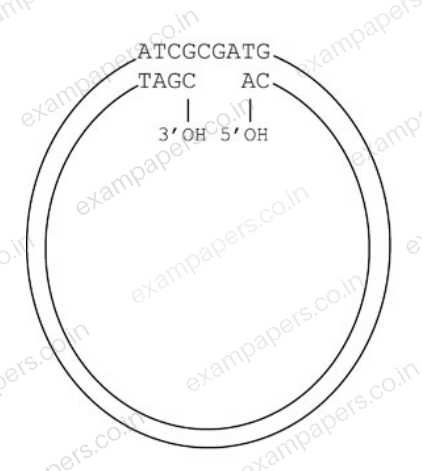
Which of the following enzyme(s) is/are required to fill the gap and generate a covalently closed circular plasmid?
[P] DNA ligase
[Q] Alkaline phosphatase
[R] DNA polymerase
[S] Polynucleotide kinase
Your answerChoose one option.
Log in to check the answer
You can attempt this question now. Sign in to view the answer key, explanations and discussion.Log in to check answerQuestion 25
Open questionBTNAT1 markNeeds review
Genomic DNA isolated from a bacterium was digested with a restriction enzyme that recognizes a 6-base pair (bp) sequence. Assuming random distribution of bases, the average length (in bp) of the fragments generated is ________
Log in to check the answer
You can attempt this question now. Sign in to view the answer key, explanations and discussion.Log in to check answerQuestion 54
Open questionBTNAT2 marksNeeds review
The product of complete digestion of the plasmid shown below with EcoRI and HaeII was purified and used as a template in a reaction containing Klenow fragment of DNA polymerase, dNTPs and [α-³²P]-dATP in a suitable reaction buffer. The product thus obtained was purified and subjected to gel electrophoresis followed by autoradiography.
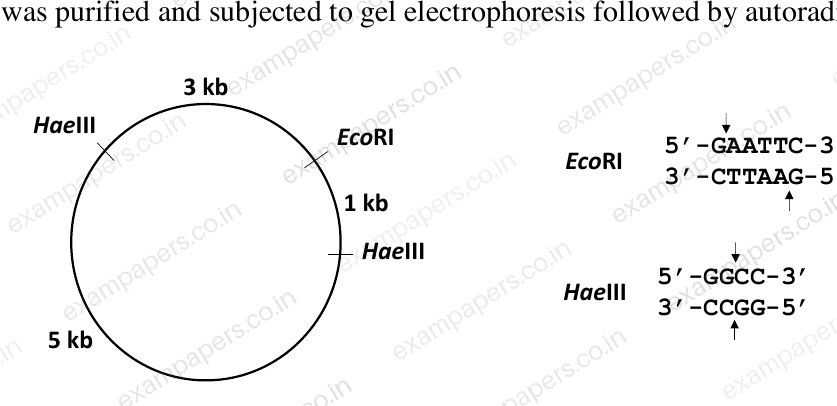
The number of bands that will appear on the X-ray film is
Log in to check the answer
You can attempt this question now. Sign in to view the answer key, explanations and discussion.Log in to check answerQuestion 43
Open questionBTMCQ2 marksNeeds review
Shown below is a plasmid vector (P) and an insert (Q). The insert was cloned into the BamHI site of the vector. The recombinant plasmid was isolated and digested with BamHI or XhoI. The results from the digestion experiments are shown in (R).
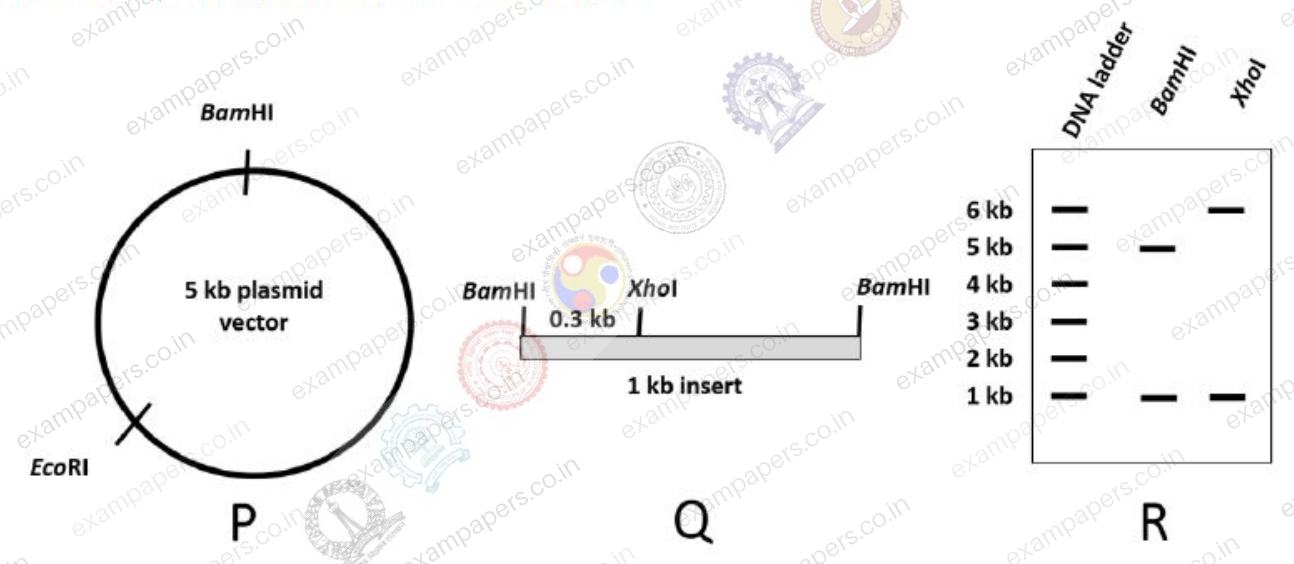
Which one of the following explains the digestion results shown in (R)?
Your answerChoose one option.
Log in to check the answer
You can attempt this question now. Sign in to view the answer key, explanations and discussion.Log in to check answerQuestion 44
Open questionBTMCQ2 marksNeeds review
Which one of the following CANNOT be a recognition sequence for a Type II restriction enzyme?
Your answerChoose one option.
Log in to check the answer
You can attempt this question now. Sign in to view the answer key, explanations and discussion.Log in to check answer