
Chemical Engineering
GATE CH Mass Transfer PYQs
Build your understanding with focused practice from past exam papers.
How to practice Mass Transfer
Attempt a question, record the concept and assumptions, then check the available answer. Rework mistakes after revising the relevant concepts. Topic tags can overlap; review the question context.
Questions 1–10 of 77. Imported answers require independent review unless marked reviewed.
Question 20
Open questionCHMCQ1 markNeeds review
A binary mixture of butane and butadiene is to be separated in an extractive distillation using furfural. Furfural lowers the activity of butadiene more than it does for butane. Consider the distillation sequence shown in the figure.
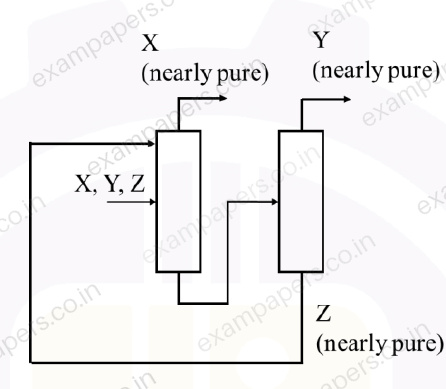
Match the component labels in Group I with chemical species in Group II.
Group I | Group II |
|---|---|
P. Component X | 1. Butane |
Q. Component Y | 2. Butadiene |
R. Component Z | 3. Furfural |
Your answerChoose one option.
Log in to check the answer
You can attempt this question now. Sign in to view the answer key, explanations and discussion.Log in to check answerQuestion 33
Open questionCHNAT1 markNeeds review
Consider a non-reactive binary mixture of two ideal gases A and B in an isothermal horizontal closed tube. Due to the concentration difference at the two ends of the tube, equimolar counterdiffusion occurs along the axial direction. No concentration gradients exist in the radial direction. The profile for partial pressure of component A (
) as a function of axial distance
is shown in the figure. The partial pressure of component B (
) approaches zero at z = 0.8 m. At a location z = z₁ the partial pressures of the components A and B are equal. The value of z₁ (in m) is _____ (rounded off to two decimal places). 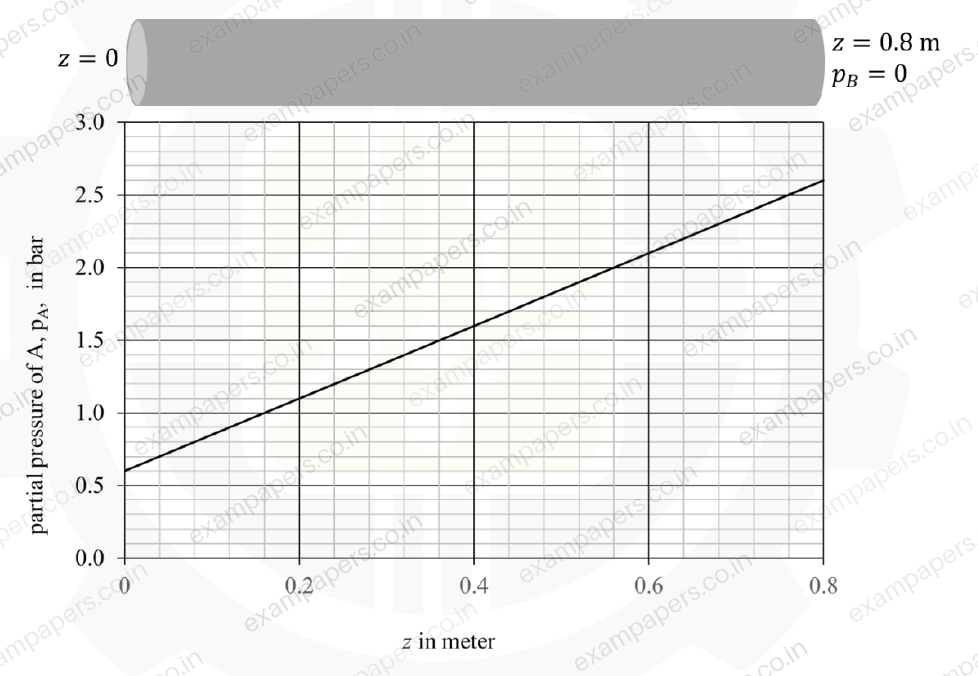
Log in to check the answer
You can attempt this question now. Sign in to view the answer key, explanations and discussion.Log in to check answerQuestion 38
Open questionCHMCQ2 marksNeeds review
Vapor pressure of water at various temperature is given in the table.
Temperature (in K) | 284 | 289 | 294 | 299 | 310 |
|---|---|---|---|---|---|
Vapor pressure of water (in kPa) | 1.28 | 1.80 | 2.50 | 3.40 | 6.40 |
An air and water vapor mixture at 100 kPa with a relative humidity of 20% has a dry-bulb temperature of 310 K. Assume latent heat of vaporization for water is 44 kJ mol
and specific heat capacity of the air and water vapor mixture is 0.035 kJ mol
K
. Which one of the following is the closest to its wet-bulb temperature (in K)?Your answerChoose one option.
Log in to check the answer
You can attempt this question now. Sign in to view the answer key, explanations and discussion.Log in to check answerQuestion 39
Open questionCHMCQ2 marksNeeds review
A volatile organic compound (VOC) is to be adsorbed from air onto a bed of activated carbon. The equilibrium capacity of activated carbon at the feed conditions is 0.4 grams VOC per gram of activated carbon. The column contains 4 grams of activated carbon per cm
of cross-section. The feed rate into the adsorber column is 0.2 grams VOC cm
h
. Breakthrough time is defined as the time at which the concentration at the exit of the bed (
) reaches a value of
, where
is the concentration of VOC in the feed. The breakthrough time for the bed is 2 h. The area under the
curve between the initial and breakthrough times is 0.1 h. Which one of the following is the fraction of unused bed at breakthrough?Your answerChoose one option.
Log in to check the answer
You can attempt this question now. Sign in to view the answer key, explanations and discussion.Log in to check answerQuestion 47
Open questionCHMCQ2 marksNeeds review
A continuous distillation column is used to separate an equimolar mixture of diethylamine (DEA) and methanol. The feed enters the column as saturated liquid at a flow rate of 30 mol s
. It is desired to obtain 92 mol% DEA as distillate. The rate of withdrawal of the distillate from the column is 10 mol s
. The equilibrium curve for the conditions in the column is given below. The latent heat of vaporization of the reboiler contents is 35 kJ mol
. Neglect heat loss to the surroundings and assume constant molal overflow. Which one of the following is the minimum reboiler heat duty (in kW)? 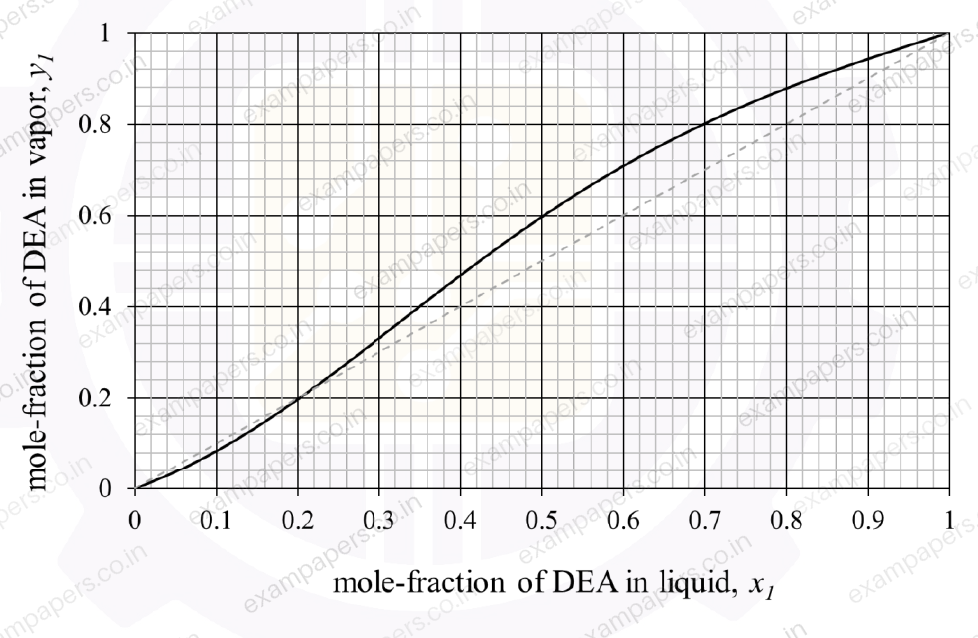
Your answerChoose one option.
Log in to check the answer
You can attempt this question now. Sign in to view the answer key, explanations and discussion.Log in to check answerQuestion 48
Open questionCHMCQ2 marksNeeds review
A gas stream with 2.01 mol % ammonia is to be scrubbed in a counter-current isothermal packed bed absorber using pure water to reduce its concentration to 0.01 mol %. Assume that dilute conditions apply, operating line is linear and the mass transfer coefficients are constant throughout the column. The liquid and the gas flows inside the absorber (in kmol m
h
) are 1000 and 200, respectively. The equilibrium relationship is
, where,
is the mole-fraction of ammonia in the gas phase and
is that in the liquid. Under these conditions, the height of overall gas transfer unit (
) is 0.8 m and the number of overall transfer units (
) is given by the following integral.
The integration is performed between the two ends of the column, and
is the equilibrium mole fraction in the gas phase, corresponding to the composition of the liquid at corresponding location. Which one of the following is the minimum length of the packing (in m) necessary to achieve the desired scrubbing?Your answerChoose one option.
Log in to check the answer
You can attempt this question now. Sign in to view the answer key, explanations and discussion.Log in to check answerQuestion 61
Open questionCHNAT2 marksNeeds review
The flooding velocity curves for two different structured packings are shown in the figure. The ratio of mass velocities of liquid (
) to that of the gas (
) is 1.27. The density of the liquid (
) is 1200 kg m⁻³ and that of the gas (
) is 1.2 kg m⁻³. For both the packings, the allowable superficial vapor velocity is 60% of flooding velocity (
). The ratio of allowable mass velocity of the vapor in packing P to that in packing Q is __________ (rounded off to one decimal place). 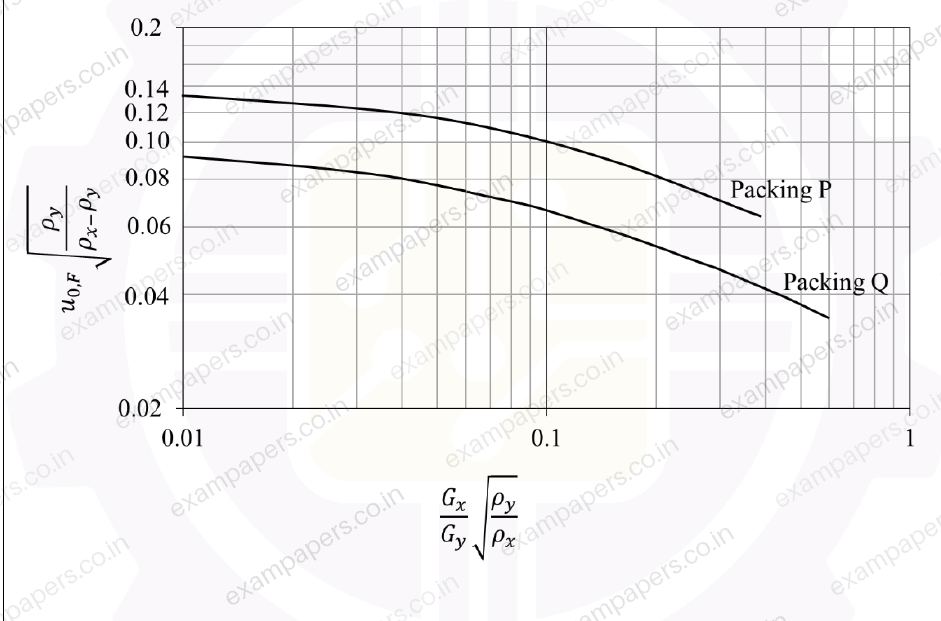
Log in to check the answer
You can attempt this question now. Sign in to view the answer key, explanations and discussion.Log in to check answerQuestion 21
Open questionCHMCQ1 markNeeds review
Schmidt number is defined as
Your answerChoose one option.
Log in to check the answer
You can attempt this question now. Sign in to view the answer key, explanations and discussion.Log in to check answerQuestion 22
Open questionCHMCQ1 markNeeds review
If
is the mass transfer coefficient and
is the molecular diffusivity, which one of the following statements is NOT CORRECT with respect to mass transfer theories?Your answerChoose one option.
Log in to check the answer
You can attempt this question now. Sign in to view the answer key, explanations and discussion.Log in to check answerQuestion 34
Open questionCHNAT1 markNeeds review
Oil is extracted from mustard seeds having 20 wt% oil and 80 wt% solids, using hexane as a solvent. After extraction, the hexane-free residual cake contains 1 wt% oil. Assuming negligible dissolution of cake in hexane, the percentage oil recovery in hexane is ____% (rounded off to the nearest integer).
Log in to check the answer
You can attempt this question now. Sign in to view the answer key, explanations and discussion.Log in to check answer