
Computer Science and Information Technology
GATE CSE concept:b-trees PYQs
Build your understanding with focused practice from past exam papers.
How to practice concept:b-trees
Attempt a question, record the concept and assumptions, then check the available answer. Rework mistakes after revising the relevant concepts. Topic tags can overlap; review the question context.
Questions 1–7 of 7. Imported answers require independent review unless marked reviewed.
Question 46
Open questionCS2MCQ2 marksNeeds review
An index in a DBMS is said to be dense if an index entry appears for every search-key value in the indexed file. Otherwise it is called a sparse index. Consider the following two statements.
S1: A hash index must be a dense index
S2: A
tree index can be a sparse indexWhich one of the following options is correct?
Your answerChoose one option.
Log in to check the answer
You can attempt this question now. Sign in to view the answer key, explanations and discussion.Log in to check answerQuestion 21
Open questionCSMSQ1 markNeeds review
Consider the following
tree with 5 nodes, in which a node can store at most 3 key values. The value 23 is now inserted in the
tree. Which of the following option(s) is/are CORRECT?Tree diagram: root keys 6, 12, 19; four leaf nodes contain, respectively, 1, 4, 3; 7, 9, 10; 13, 15, 17; and 20, 21, 22.
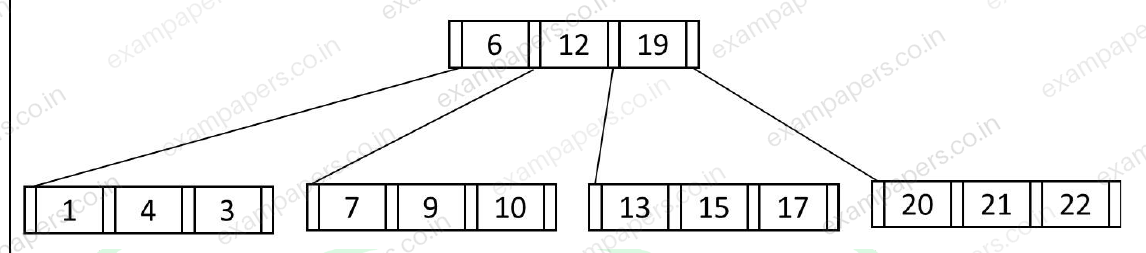
Your answerSelect all correct options. You can choose more than one.
Log in to check the answer
You can attempt this question now. Sign in to view the answer key, explanations and discussion.Log in to check answerQuestion 57
Open questionCSNAT2 marksNeeds review
In a B⁺- tree where each node can hold at most four key values, a root to leaf path consists of the following nodes:
A = (49, 77, 83, -), B = (7, 19, 33, 44), C = (20*, 22*, 25*, 26*)
The *-marked keys signify that these are data entries in a leaf.
Assume that a pointer between keys
and
points to a subtree containing keys in
, and that when a leaf is created, the smallest key in it is copied up into its parent.A record with key value 23 is inserted into the B⁺- tree.
The smallest key value in the parent of the leaf that contains 25* is __________. (Answer in integer)
Log in to check the answer
You can attempt this question now. Sign in to view the answer key, explanations and discussion.Log in to check answerQuestion 21
Open questionCS1MCQ1 markNeeds review
In a B+ tree, the requirement of at least half-full (50%) node occupancy is relaxed for which one of the following cases?
Your answerChoose one option.
Log in to check the answer
You can attempt this question now. Sign in to view the answer key, explanations and discussion.Log in to check answerQuestion 54
Open questionCSNAT2 marksNeeds review
Consider a database implemented using B+ tree for file indexing and installed on a disk drive with block size of 4 KB. The size of search key is 12 bytes and the size of tree/disk pointer is 8 bytes. Assume that the database has one million records. Also assume that no node of the B+ tree and no records are present initially in main memory. Consider that each record fits into one disk block. The minimum number of disk accesses required to retrieve any record in the database is ______.
Log in to check the answer
You can attempt this question now. Sign in to view the answer key, explanations and discussion.Log in to check answerQuestion 14
Open questionCSMCQ1 markNeeds review
Which one of the following statements is NOT correct about the B+ tree data structure used for creating an index of a relational database table?
Your answerChoose one option.
Log in to check the answer
You can attempt this question now. Sign in to view the answer key, explanations and discussion.Log in to check answerQuestion 49
Open questionCSNAT2 marksNeeds review
In a B+ tree, if the search-key value is 8 bytes long, the block size is 512 bytes and the block pointer size is 2 bytes, then the maximum order of the B+ tree is __________.
Log in to check the answer
You can attempt this question now. Sign in to view the answer key, explanations and discussion.Log in to check answer