
Computer Science and Information Technology
GATE CSE concept:distance-vector PYQs
Build your understanding with focused practice from past exam papers.
How to practice concept:distance-vector
Attempt a question, record the concept and assumptions, then check the available answer. Rework mistakes after revising the relevant concepts. Topic tags can overlap; review the question context.
Questions 1–4 of 4. Imported answers require independent review unless marked reviewed.
Question 17
Open questionCSMCQ1 markNeeds review
Consider the routing protocols given in List I and the names given in List II:
List I | List II
(i) Distance vector routing | (a) Bellman-Ford
(ii) Link state routing | (b) Dijkstra
For matching of items in List I with those in List II, which ONE of the following options is CORRECT?
Your answerChoose one option.
Log in to check the answer
You can attempt this question now. Sign in to view the answer key, explanations and discussion.Log in to check answerQuestion 57
Open questionCSNAT2 marksNeeds review
Consider a network with three routers P, Q, R shown in the figure below. All the links have cost of unity.
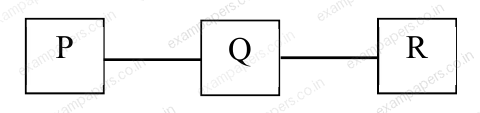
The routers exchange distance vector routing information and have converged on the routing tables, after which the link Q–R fails. Assume that P and Q send out routing updates at random times, at the same average rate. The probability of a routing loop forming (rounded off to one decimal place) between P and Q, leading to count-to-infinity problem, is __________.
Log in to check the answer
You can attempt this question now. Sign in to view the answer key, explanations and discussion.Log in to check answerQuestion 45
Open questionCSMSQ2 marksNeeds review
Consider a computer network using the distance vector routing algorithm in its network layer. The partial topology of the network is as shown below.
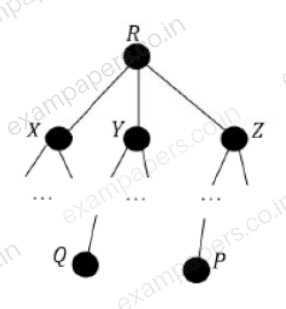
The objective is to find the shortest-cost path from the router
to routers
and
. Assume that
does not initially know the shortest routes to
and
. Assume that
has three neighboring routers denoted as
,
, and
. During one iteration,
measures its distance to its neighbours
,
, and
as 3, 2, and 5, respectively. Router
gets routing vectors from its neighbours that indicate that the distance to router
from routers
,
, and
are 7, 6, and 5, respectively. The routing vector also indicates that the distance to router
from routers
,
, and
are 4, 6, and 8, respectively. Which of the following statement(s) is/are correct with respect to the new routing table of
, after update during this iteration?Your answerSelect all correct options. You can choose more than one.
Log in to check the answer
You can attempt this question now. Sign in to view the answer key, explanations and discussion.Log in to check answerQuestion 9
Open questionCSMCQ1 markNeeds review
Consider the following statements about the routing protocols, Routing Information Protocol (RIP) and Open Shortest Path First (OSPF) in an IPv4 network.
I: RIP uses distance vector routing
II: RIP packets are sent using UDP
III: OSPF packets are sent using TCP
IV: OSPF operation is based on link-state routing
Which of the statements above are CORRECT?
Your answerChoose one option.
Log in to check the answer
You can attempt this question now. Sign in to view the answer key, explanations and discussion.Log in to check answer