
Computer Science and Information Technology
GATE CSE format:mcq PYQs
Build your understanding with focused practice from past exam papers.
Questions 411–420 of 534. Imported answers require independent review unless marked reviewed.
Question 8
Open questionGAMCQ2 marksNeeds review
In a party, 60% of the invited guests are male and 40% are female. If 80% of the invited guests attended the party and if all the invited female guests attended, what would be the ratio of males to females among the attendees in the party?
Your answerChoose one option.
Log in to check the answer
You can attempt this question now. Sign in to view the answer key, explanations and discussion.Log in to check answerQuestion 9
Open questionGAMCQ2 marksNeeds review
In the figure below,
is equal to ____________ . 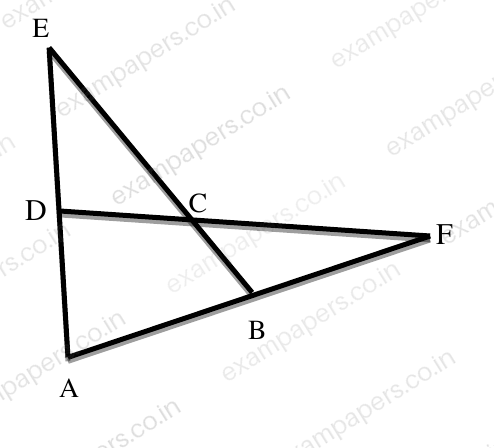
Your answerChoose one option.
Log in to check the answer
You can attempt this question now. Sign in to view the answer key, explanations and discussion.Log in to check answerQuestion 10
Open questionGAMCQ2 marksNeeds review
A six sided unbiased die with four green faces and two red faces is rolled seven times. Which of the following combinations is the most likely outcome of the experiment?
Your answerChoose one option.
Log in to check the answer
You can attempt this question now. Sign in to view the answer key, explanations and discussion.Log in to check answerQuestion 1
Open questionCSMCQ1 markNeeds review
Which one of the following is a closed form expression for the generating function of the sequence
, where
for all
?Your answerChoose one option.
Log in to check the answer
You can attempt this question now. Sign in to view the answer key, explanations and discussion.Log in to check answerQuestion 2
Open questionCSMCQ1 markNeeds review
Consider the following C program:
#include<stdio.h>
struct Uronde{
char x,y,z;
};
int main(){
struct Uronde p = {'1', '0', 'a'+2};
struct Uronde *q = &p;
printf("%c, %c", *((char*)q+1), *((char*)q+2));
return 0;
}
The output of this program is:
Your answerChoose one option.
Log in to check the answer
You can attempt this question now. Sign in to view the answer key, explanations and discussion.Log in to check answerQuestion 3
Open questionCSMCQ1 markNeeds review
A queue is implemented using a non-circular singly linked list. The queue has a head pointer and a tail pointer, as shown in the figure. Let n denote the number of nodes in the queue. Let enqueue be implemented by inserting a new node at the head, and dequeue be implemented by deletion of a node from the tail.

Which one of the following is the time complexity of the most time-efficient implementation of enqueue and dequeue, respectively, for this data structure?
Your answerChoose one option.
Log in to check the answer
You can attempt this question now. Sign in to view the answer key, explanations and discussion.Log in to check answerQuestion 4
Open questionCSMCQ1 markNeeds review
Let ⊕ and ⊙ denote the Exclusive OR and Exclusive NOR operations, respectively. Which one of the following is NOT CORRECT?
Your answerChoose one option.
Log in to check the answer
You can attempt this question now. Sign in to view the answer key, explanations and discussion.Log in to check answerQuestion 5
Open questionCSMCQ1 markNeeds review
Consider the following processor design characteristics.
I. Register-to-register arithmetic operations only
II. Fixed-length instruction format
III. Hardwired control unit
Which of the characteristics above are used in the design of a RISC processor?
Your answerChoose one option.
Log in to check the answer
You can attempt this question now. Sign in to view the answer key, explanations and discussion.Log in to check answerQuestion 6
Open questionCSMCQ1 markNeeds review
Let N be an NFA with n states. Let k be the number of states of a minimal DFA which is equivalent to N. Which one of the following is necessarily true?
Your answerChoose one option.
Log in to check the answer
You can attempt this question now. Sign in to view the answer key, explanations and discussion.Log in to check answerQuestion 7
Open questionCSMCQ1 markNeeds review
The set of all recursively enumerable languages is
Your answerChoose one option.
Log in to check the answer
You can attempt this question now. Sign in to view the answer key, explanations and discussion.Log in to check answer