
Computer Science and Information Technology
GATE CSE Operating System PYQs
Build your understanding with focused practice from past exam papers.
Questions 41–50 of 65. Imported answers require independent review unless marked reviewed.
Question 43
Open questionCSMSQ2 marksNeeds review
Consider a computer system with multiple shared resource types, with one instance per resource type. Each instance can be owned by only one process at a time. Owning and freeing of resources are done by holding a global lock (L). The following scheme is used to own a resource instance:
function OwnResource(Resource R)
Acquire lock L // a global lock
if R is available then
Acquire R
Release lock L
else
if R is owned by another process P then
Terminate P, after releasing all resources owned by P
Acquire R
Restart P
Release lock L
end if
end if
end function
Which of the following choice(s) about the above scheme is/are correct?
Your answerSelect all correct options. You can choose more than one.
Log in to check the answer
You can attempt this question now. Sign in to view the answer key, explanations and discussion.Log in to check answerQuestion 46
Open questionCSMSQ2 marksNeeds review
Consider the following pseudocode, where S is a semaphore initialized to 5 in line#2 and counter is a shared variable initialized to 0 in line#1. Assume that the increment operation in line#7 is not atomic.
int counter = 0;
Semaphore S = init(5);
void parop(void)
{
wait(S);
wait(S);
counter++;
signal(S);
signal(S);
}
If five threads execute the function parop concurrently, which of the following program behavior(s) is/are possible?
Your answerSelect all correct options. You can choose more than one.
Log in to check the answer
You can attempt this question now. Sign in to view the answer key, explanations and discussion.Log in to check answerQuestion 11
Open questionCSMCQ1 markNeeds review
Consider allocation of memory to a new process. Assume that none of the existing holes in the memory will exactly fit the process’s memory requirement. Hence, a new hole of smaller size will be created if allocation is made in any of the existing holes. Which one of the following statements is TRUE?
Your answerChoose one option.
Log in to check the answer
You can attempt this question now. Sign in to view the answer key, explanations and discussion.Log in to check answerQuestion 12
Open questionCSMCQ1 markNeeds review
Consider the following statements about process state transitions for a system using preemptive scheduling.
I. A running process can move to ready state.
II. A ready process can move to running state.
III. A blocked process can move to running state.
IV. A blocked process can move to ready state.
Which of the above statements are TRUE?
Your answerChoose one option.
Log in to check the answer
You can attempt this question now. Sign in to view the answer key, explanations and discussion.Log in to check answerQuestion 34
Open questionCSMCQ2 marksNeeds review
Each of a set of
processes executes the following code using two semaphores a and b initialized to 1 and 0, respectively. Assume that count is a shared variable initialized to 0 and not used in CODE SECTION P. 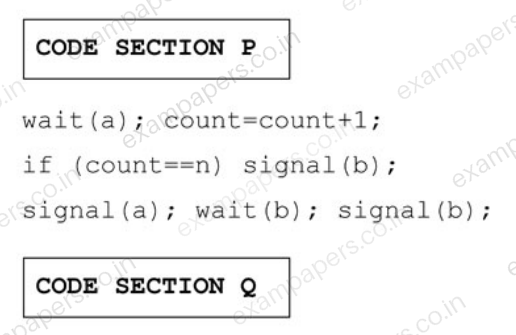
What does the code achieve?
Your answerChoose one option.
Log in to check the answer
You can attempt this question now. Sign in to view the answer key, explanations and discussion.Log in to check answerQuestion 35
Open questionCSMCQ2 marksNeeds review
Consider the following five disk access requests of the form (request id, cylinder number) that are present in the disk scheduler queue at a given time. (P, 155), (Q, 85), (R, 110), (S, 30), (T, 115) Assume the head is positioned at cylinder 100. The scheduler follows Shortest Seek Time First scheduling to service the requests. Which one of the following statements is FALSE?
Your answerChoose one option.
Log in to check the answer
You can attempt this question now. Sign in to view the answer key, explanations and discussion.Log in to check answerQuestion 50
Open questionCSNAT2 marksNeeds review
Consider the following set of processes, assumed to have arrived at time 0. Consider the CPU scheduling algorithms Shortest Job First (SJF) and Round Robin (RR). For RR, assume that the processes are scheduled in the order
.Process | | | | |
|---|---|---|---|---|
Burst time (in ms) | 8 | 7 | 2 | 4 |
If the time quantum for RR is 4 ms, then the absolute value of the difference between the average turnaround times (in ms) of SJF and RR (round off to 2 decimal places) is ______.
Log in to check the answer
You can attempt this question now. Sign in to view the answer key, explanations and discussion.Log in to check answerQuestion 17
Open questionCSNAT1 markNeeds review
The following C program is executed on a Unix/Linux system:
#include <unistd.h>
int main()
{
int i;
for (i=0; i<10; i++)
if (i%2 == 0) fork();
return 0;
}
The total number of child processes created is __________.
Log in to check the answer
You can attempt this question now. Sign in to view the answer key, explanations and discussion.Log in to check answerQuestion 23
Open questionCSNAT1 markNeeds review
Consider three concurrent processes P1, P2 and P3 as shown below, which access a shared variable D that has been initialized to 100.
P1 | P2 | P3 |
|---|---|---|
⋮ | ⋮ | ⋮ |
D = D + 20 | D = D − 50 | D = D + 10 |
⋮ | ⋮ | ⋮ |
The processes are executed on a uniprocessor system running a time-shared operating system. If the minimum and maximum possible values of D after the three processes have completed execution are X and Y respectively, then the value of Y − X is ______________.
Log in to check the answer
You can attempt this question now. Sign in to view the answer key, explanations and discussion.Log in to check answerQuestion 39
Open questionCSMCQ2 marksNeeds review
Consider the following snapshot of a system running
concurrent processes. Process
is holding
instances of a resource R,
. Assume that all instances of R are currently in use. Further, for all
, process
can place a request for at most
additional instances of R while holding the
instances it already has. Of the
processes, there are exactly two processes
and
such that
. Which one of the following conditions guarantees that no other process apart from
and
can complete execution?Your answerChoose one option.
Log in to check the answer
You can attempt this question now. Sign in to view the answer key, explanations and discussion.Log in to check answer