
Computer Science and Information Technology
GATE CSE topic:computer-networks PYQs
Build your understanding with focused practice from past exam papers.
Questions 11–20 of 72. Imported answers require independent review unless marked reviewed.
Question 65
Open questionCS2NAT2 marksNeeds review
It is necessary to design a link-layer protocol between two hosts that are directly connected over a lossless link of length 300 kilometers. Assume that the link bandwidth is
bits per second and that the propagation delay in the link is 5 nanoseconds per meter. Every transmitted data byte is assigned a unique sequence number.Let
be the minimum number of bits needed for the sequence number field in the protocol header such thati. the sequence numbers do not wrap around before 60 seconds, and
ii. the maximum utilization of the link is achieved.
The value of
is ______. (answer in integer)Log in to check the answer
You can attempt this question now. Sign in to view the answer key, explanations and discussion.Log in to check answerQuestion 16
Open questionCSMCQ1 markNeeds review
Identify the ONE CORRECT matching between the OSI layers and their corresponding functionalities as shown.
OSI Layers | Functionalities |
|---|---|
(a) Network layer | (I) Packet routing |
(b) Transport layer | (II) Frame and error handling |
(c) Datalink layer | (III) Host to host communication |
Your answerChoose one option.
Log in to check the answer
You can attempt this question now. Sign in to view the answer key, explanations and discussion.Log in to check answerQuestion 16
Open questionCSMCQ1 markNeeds review
Consider the following statements:
(i) Address Resolution Protocol (AR) provides a mapping from an IP address to the corresponding hardware (link-layer) address.
(ii) A single TCP segment from a sender S to a receiver R cannot carry both data from S to R and acknowledgement for a segment from R to S.
Which ONE of the following is CORRECT?
Your answerChoose one option.
Log in to check the answer
You can attempt this question now. Sign in to view the answer key, explanations and discussion.Log in to check answerQuestion 17
Open questionCSMCQ1 markNeeds review
Consider the routing protocols given in List I and the names given in List II:
List I | List II
(i) Distance vector routing | (a) Bellman-Ford
(ii) Link state routing | (b) Dijkstra
For matching of items in List I with those in List II, which ONE of the following options is CORRECT?
Your answerChoose one option.
Log in to check the answer
You can attempt this question now. Sign in to view the answer key, explanations and discussion.Log in to check answerQuestion 18
Open questionCSMCQ1 markNeeds review
A machine receives an IPv4 datagram. The protocol field of the IPv4 header has the protocol number of a protocol X.
Which ONE of the following is NOT a possible candidate for X?
Your answerChoose one option.
Log in to check the answer
You can attempt this question now. Sign in to view the answer key, explanations and discussion.Log in to check answerQuestion 22
Open questionCSMSQ1 markNeeds review
Consider the 3-way handshaking protocol for TCP connection establishment. Let the three packets exchanged during the connection establishment be denoted as P1, P2, and P3, in order. Which of the following option(s) is/are TRUE with respect to TCP header flags that are set in the packets?
Your answerSelect all correct options. You can choose more than one.
Log in to check the answer
You can attempt this question now. Sign in to view the answer key, explanations and discussion.Log in to check answerQuestion 23
Open questionCSMCQ1 markNeeds review
Consider a network that uses Ethernet and IPv4. Assume that IPv4 headers do not use any options field. Each Ethernet frame can carry a maximum of 1500 bytes in its data field. A UDP segment is transmitted. The payload (data) in the UDP segment is 7488 bytes.
Which ONE of the following choices has the CORRECT total number of fragments transmitted and the size of the last fragment including IPv4 header?
Your answerChoose one option.
Log in to check the answer
You can attempt this question now. Sign in to view the answer key, explanations and discussion.Log in to check answerQuestion 36
Open questionCSMCQ2 marksNeeds review
Suppose we are transmitting frames between two nodes using Stop-and-Wait protocol. The frame size is 3000 bits. The transmission rate of the channel is 2000 bps (bits/second) and the propagation delay between the two nodes is 100 milliseconds. Assume that the processing times at the source and destination are negligible. Also, assume that the size of the acknowledgment packet is negligible. Which ONE of the following most accurately gives the channel utilization for the above scenario in percentage?
Your answerChoose one option.
Log in to check the answer
You can attempt this question now. Sign in to view the answer key, explanations and discussion.Log in to check answerQuestion 40
Open questionCSMCQ2 marksNeeds review
A packet with the destination IP address 145.36.109.70 arrives at a router whose routing table is shown. Which interface will the packet be forwarded to?
Subnet Address | Subnet Mask (in CIDR notation) | Interface |
|---|---|---|
145.36.0.0 | /16 | E1 |
145.36.128.0 | /17 | E2 |
145.36.64.0 | /18 | E3 |
145.36.255.0 | /24 | E4 |
Default | -- | E5 |
Your answerChoose one option.
Log in to check the answer
You can attempt this question now. Sign in to view the answer key, explanations and discussion.Log in to check answerQuestion 57
Open questionCSNAT2 marksNeeds review
Suppose a message of size 1500 bytes is transmitted from a source to a destination using IPv4 protocol via two routers as shown in the figure. Each router has a defined maximum transmission unit (MTU) as shown in the figure, including IP header. The number of fragments that will be delivered to the destination is _______. (Answer in integer)
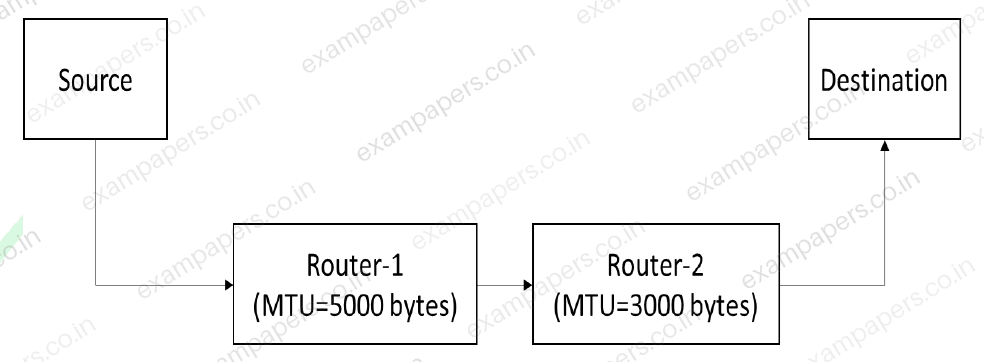
Log in to check the answer
You can attempt this question now. Sign in to view the answer key, explanations and discussion.Log in to check answer