
Computer Science and Information Technology
GATE CSE topic:computing PYQs
Build your understanding with focused practice from past exam papers.
Questions 871–880 of 975. Imported answers require independent review unless marked reviewed.
Question 13
Open questionCSMCQ1 markNeeds review
A circular queue has been implemented using a singly linked list where each node consists of a value and a single pointer pointing to the next node. We maintain exactly two external pointers FRONT and REAR pointing to the front node and the rear node of the queue, respectively. Which of the following statements is/are CORRECT for such a circular queue, so that insertion and deletion operations can be performed in
time?I. Next pointer of front node points to the rear node.
II. Next pointer of rear node points to the front node.
Your answerChoose one option.
Log in to check the answer
You can attempt this question now. Sign in to view the answer key, explanations and discussion.Log in to check answerQuestion 14
Open questionCSMCQ1 markNeeds review
Consider a TCP client and a TCP server running on two different machines. After completing data transfer, the TCP client calls close to terminate the connection and a FIN segment is sent to the TCP server. Server-side TCP responds by sending an ACK, which is received by the client-side TCP. As per the TCP connection state diagram (RFC 793), in which state does the client-side TCP connection wait for the FIN from the server-side TCP?
Your answerChoose one option.
Log in to check the answer
You can attempt this question now. Sign in to view the answer key, explanations and discussion.Log in to check answerQuestion 14
Open questionCSMCQ1 markNeeds review
Consider the following function implemented in C:
void printxy(int x, int y) {
int *ptr;
x = 0;
ptr = &x;
y = *ptr;
*ptr = 1;
printf("%d,%d", x, y);
}
The output of invoking printxy(1,1) is
Your answerChoose one option.
Log in to check the answer
You can attempt this question now. Sign in to view the answer key, explanations and discussion.Log in to check answerQuestion 15
Open questionCSMCQ1 markNeeds review
A sender S sends a message m to receiver R, which is digitally signed by S with its private key. In this scenario, one or more of the following security violations can take place.
(I) S can launch a birthday attack to replace m with a fraudulent message.
(II) A third party attacker can launch a birthday attack to replace m with a fraudulent message.
(III) R can launch a birthday attack to replace m with a fraudulent message.
Which of the following are possible security violations?
Your answerChoose one option.
Log in to check the answer
You can attempt this question now. Sign in to view the answer key, explanations and discussion.Log in to check answerQuestion 15
Open questionCSMCQ1 markNeeds review
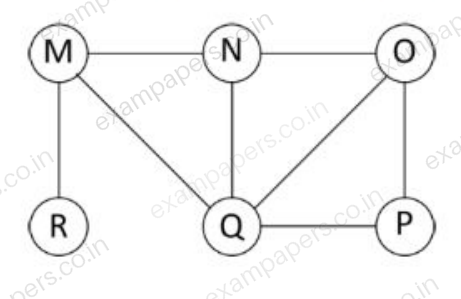
The Breadth First Search (BFS) algorithm has been implemented using the queue data structure. Which one of the following is a possible order of visiting the nodes in the graph below?
Your answerChoose one option.
Log in to check the answer
You can attempt this question now. Sign in to view the answer key, explanations and discussion.Log in to check answerQuestion 16
Open questionCSMCQ1 markNeeds review
The following functional dependencies hold true for the relational schema R:
V → W
VW → X
Y → VX
Y → Z
Which of the following is irreducible equivalent for this set of functional dependencies?
Your answerChoose one option.
Log in to check the answer
You can attempt this question now. Sign in to view the answer key, explanations and discussion.Log in to check answerQuestion 16
Open questionCSMCQ1 markNeeds review
Identify the language generated by the following grammar, where S is the start variable.
Your answerChoose one option.
Log in to check the answer
You can attempt this question now. Sign in to view the answer key, explanations and discussion.Log in to check answerQuestion 17
Open questionCSMCQ1 markNeeds review
Consider the following grammar:
P → xQRS
Q → yZ | z
R → w | ε
S → y
What is FOLLOW(Q)?
Your answerChoose one option.
Log in to check the answer
You can attempt this question now. Sign in to view the answer key, explanations and discussion.Log in to check answerQuestion 17
Open questionCSMCQ1 markNeeds review
An ER model of a database consists of entity types A and B. These are connected by a relationship R which does not have its own attribute. Under which one of the following conditions, can the relational table for R be merged with that of A?
Your answerChoose one option.
Log in to check the answer
You can attempt this question now. Sign in to view the answer key, explanations and discussion.Log in to check answerQuestion 18
Open questionCSMCQ1 markNeeds review
Threads of a process share
Your answerChoose one option.
Log in to check the answer
You can attempt this question now. Sign in to view the answer key, explanations and discussion.Log in to check answer