
Computer Science and Information Technology
GATE CSE topic:information-technology PYQs
Build your understanding with focused practice from past exam papers.
Questions 841–850 of 975. Imported answers require independent review unless marked reviewed.
Question 51
Open questionCSNAT2 marksNeeds review
A processor has 16 integer registers (R0, R1, ..., R15) and 64 floating point registers (F0, F1, ..., F63). It uses a 2-byte instruction format. There are four categories of instructions: Type-1, Type-2, Type-3, and Type-4. Type-1 category consists of four instructions, each with 3 integer register operands (3Rs). Type-2 category consists of eight instructions, each with 2 floating point register operands (2Fs). Type-3 category consists of fourteen instructions, each with one integer register operand and one floating point register operand (1R+1F). Type-4 category consists of N instructions, each with a floating point register operand (1F).
The maximum value of N is __________.
Log in to check the answer
You can attempt this question now. Sign in to view the answer key, explanations and discussion.Log in to check answerQuestion 52
Open questionCSNAT2 marksNeeds review
Given a language
, define
as follows:
for all
The order of a language
is defined as the smallest k such that
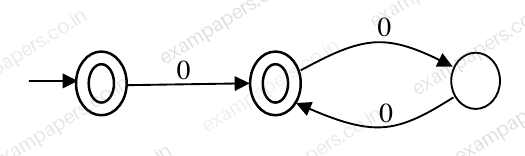
. Consider the language
(over alphabet 0) accepted by the following automaton.The order of
is _____.Log in to check the answer
You can attempt this question now. Sign in to view the answer key, explanations and discussion.Log in to check answerQuestion 53
Open questionCSNAT2 marksNeeds review
Consider a storage disk with 4 platters (numbered as 0, 1, 2 and 3), 200 cylinders (numbered as 0, 1, ..., 199) and 256 sectors per track (numbered as 0, 1, ..., 255). The following 6 disk requests of the form [sector number, cylinder number, platter number] are received by the disk controller at the same time:
[120, 72, 2], [180, 134, 1], [60, 20, 0], [212, 86, 3], [56, 116, 2], [118, 16, 1]
Currently the head is positioned at sector number 100 of cylinder 80, and is moving towards higher cylinder numbers. The average power dissipation in moving the head over 100 cylinders is 20 milliwatts and for reversing the direction of the head movement once is 15 milliwatts. Power dissipation associated with rotational latency and switching of head between different platters is negligible.
The total power consumption in milliwatts to satisfy all of the above disk requests using the Shortest Seek Time First disk scheduling algorithm is _____.
Log in to check the answer
You can attempt this question now. Sign in to view the answer key, explanations and discussion.Log in to check answerQuestion 54
Open questionCSNAT2 marksNeeds review
Consider an IP packet with a length of 4,500 bytes that includes a 20-byte IPv4 header and a 40-byte TCP header. The packet is forwarded to an IPv4 router that supports a Maximum Transmission Unit (MTU) of 600 bytes. Assume that the length of the IP header in all the outgoing fragments of this packet is 20 bytes. Assume that the fragmentation offset value stored in the first fragment is 0.
The fragmentation offset value stored in the third fragment is _____.
Log in to check the answer
You can attempt this question now. Sign in to view the answer key, explanations and discussion.Log in to check answerQuestion 55
Open questionCSNAT2 marksNeeds review
Consider a simple communication system where multiple nodes are connected by a shared broadcast medium (like Ethernet or wireless). The nodes in the system use the following carrier-sense based medium access protocol. A node that receives a packet to transmit will carrier-sense the medium for 5 units of time. If the node does not detect any other transmission in this duration, it starts transmitting its packet in the next time unit. If the node detects another transmission, it waits until this other transmission finishes, and then begins to carrier-sense for 5 time units again. Once the start to transmit, nodes do not perform any collision detection and continue transmission even if a collision occurs. All transmissions last for 20 units of time. Assume that the transmission signal travels at the speed of 10 meters per unit time in the medium.
Assume that the system has two nodes P and Q, located at a distance d meters from each other. P starts transmitting a packet at time t=0 after successfully completing its carrier-sense phase. Node Q has a packet to transmit at time t=0 and begins to carrier-sense the medium.
The maximum distance d (in meters, rounded to the closest integer) that allows Q to successfully avoid a collision between its proposed transmission and P’s ongoing transmission is _____.
Log in to check the answer
You can attempt this question now. Sign in to view the answer key, explanations and discussion.Log in to check answerQuestion 1
Open questionCSMCQ1 markNeeds review
The statement
is logically equivalent to which of the statements below?I.
II.
III.
IV.
Your answerChoose one option.
Log in to check the answer
You can attempt this question now. Sign in to view the answer key, explanations and discussion.Log in to check answerQuestion 1
Open questionCSMCQ1 markNeeds review
The representation of the value of a 16-bit unsigned integer X in hexadecimal number system is BCA9. The representation of the value of X in octal number system is
Your answerChoose one option.
Log in to check the answer
You can attempt this question now. Sign in to view the answer key, explanations and discussion.Log in to check answerQuestion 2
Open questionCSMCQ1 markNeeds review
Consider the first-order logic sentence
. Assuming non-empty logical domains, which of the sentences below are implied by
?I.
II.
III.
IV.
Your answerChoose one option.
Log in to check the answer
You can attempt this question now. Sign in to view the answer key, explanations and discussion.Log in to check answerQuestion 2
Open questionCSMCQ1 markNeeds review
Match the following:
(P) static char var;
(Q) m = malloc(10);
m = NULL;
(R) char *ptr[10];
(S) register int var;
(i) Sequence of memory locations to store addresses
(ii) A variable located in data section of memory
(iii) Request to allocate a CPU register to store data
(iv) A lost memory which cannot be freed
Your answerChoose one option.
Log in to check the answer
You can attempt this question now. Sign in to view the answer key, explanations and discussion.Log in to check answerQuestion 3
Open questionCSMCQ1 markNeeds review
Let
be scalars, not all zero, such that
where
are column vectors in
. Consider the set of linear equations
where
and
. The set of equations hasYour answerChoose one option.
Log in to check the answer
You can attempt this question now. Sign in to view the answer key, explanations and discussion.Log in to check answer