
Computer Science and Information Technology
GATE CSE topic:theory-computation PYQs
Build your understanding with focused practice from past exam papers.
Questions 61–70 of 83. Imported answers require independent review unless marked reviewed.
Question 31
Open questionCSMCQ2 marksNeeds review
Which one of the following languages over
is NOT context-free?Your answerChoose one option.
Log in to check the answer
You can attempt this question now. Sign in to view the answer key, explanations and discussion.Log in to check answerQuestion 34
Open questionCSMCQ2 marksNeeds review
Consider the following sets:
S1. Set of all recursively enumerable languages over the alphabet
S2. Set of all syntactically valid C programs
S3. Set of all languages over the alphabet
S4. Set of all non-regular languages over the alphabet
Which of the above sets are uncountable?Your answerChoose one option.
Log in to check the answer
You can attempt this question now. Sign in to view the answer key, explanations and discussion.Log in to check answerQuestion 48
Open questionCSNAT2 marksNeeds review
Let Σ be the set of all bijections from {1, ..., 5} to {1, ..., 5}, where id denotes the identity function, i.e. id(i) = i, ∀i. Let ∘ denote composition on functions. For a string x = x₁ x₂ ··· xₙ ∈ Σⁿ, n ≥ 0, let π(x) = x₁ ∘ x₂ ∘ ··· ∘ xₙ. Consider the language L = {x ∈ Σ* | π(x) = id}. The minimum number of states in any DFA accepting L is ________.
Log in to check the answer
You can attempt this question now. Sign in to view the answer key, explanations and discussion.Log in to check answerQuestion 54
Open questionCSNAT2 marksNeeds review
In an RSA cryptosystem, the value of the public modulus parameter n is 307. If it is also known that φ(n) = 288, where φ() denotes Euler’s Totient Function, then the prime factor of n which is greater than 50 is ________.
Log in to check the answer
You can attempt this question now. Sign in to view the answer key, explanations and discussion.Log in to check answerQuestion 6
Open questionCSMCQ1 markNeeds review
Let N be an NFA with n states. Let k be the number of states of a minimal DFA which is equivalent to N. Which one of the following is necessarily true?
Your answerChoose one option.
Log in to check the answer
You can attempt this question now. Sign in to view the answer key, explanations and discussion.Log in to check answerQuestion 7
Open questionCSMCQ1 markNeeds review
The set of all recursively enumerable languages is
Your answerChoose one option.
Log in to check the answer
You can attempt this question now. Sign in to view the answer key, explanations and discussion.Log in to check answerQuestion 28
Open questionCSMCQ2 marksNeeds review
Consider the first-order logic sentence
where
is a quantifier-free first-order logic formula using only predicate symbols, and possibly equality, but no function symbols. Suppose
has a model with a universe containing 7 elements.
Which one of the following statements is necessarily true?Your answerChoose one option.
Log in to check the answer
You can attempt this question now. Sign in to view the answer key, explanations and discussion.Log in to check answerQuestion 35
Open questionCSMCQ2 marksNeeds review
Consider the following languages:
I.
II.
III.
IV.
Which of the languages above are context-free?
Your answerChoose one option.
Log in to check the answer
You can attempt this question now. Sign in to view the answer key, explanations and discussion.Log in to check answerQuestion 36
Open questionCSMCQ2 marksNeeds review
Consider the following problems.
denotes the language generated by a grammar
.
denotes the language accepted by a machine
.(I) For an unrestricted grammar
and a string
, whether
(II) Given a Turing machine
, whether
is regular
(III) Given two grammars
and
, whether
(IV) Given an NFA
, whether there is a deterministic PDA
such that
and
accept the same language.Which one of the following statements is correct?
Your answerChoose one option.
Log in to check the answer
You can attempt this question now. Sign in to view the answer key, explanations and discussion.Log in to check answerQuestion 52
Open questionCSNAT2 marksNeeds review
Given a language
, define
as follows:
for all
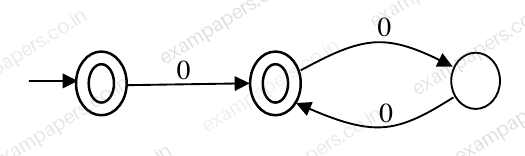
The order of a language
is defined as the smallest k such that
. Consider the language
(over alphabet 0) accepted by the following automaton.The order of
is _____.Log in to check the answer
You can attempt this question now. Sign in to view the answer key, explanations and discussion.Log in to check answer