
Computer Science and Information Technology
GATE CSE year:2018 PYQs
Build your understanding with focused practice from past exam papers.
Questions 51–60 of 65. Imported answers require independent review unless marked reviewed.
Question 41
Open questionCSMCQ2 marksNeeds review
Consider the relations r(A, B) and s(B, C), where s.B is a primary key and r.B is a foreign key referencing s.B. Consider the query
Let LOJ denote the natural left outer-join operation. Assume that r and s contain no null values.
Which one of the following queries is NOT equivalent to Q?
Your answerChoose one option.
Log in to check the answer
You can attempt this question now. Sign in to view the answer key, explanations and discussion.Log in to check answerQuestion 42
Open questionCSMCQ2 marksNeeds review
Consider the following four relational schemas. For each schema, all non-trivial functional dependencies are listed. The underlined attributes are the respective primary keys.
Schema I: Registration (rollno, courses)
Field ‘courses’ is a set-valued attribute containing the set of courses a student has registered for.
Non-trivial functional dependency:
rollno → courses
Schema II: Registration (rollno, courseid, email)
Non-trivial functional dependencies:
rollno, courseid → email
email → rollno
Schema III: Registration (rollno, courseid, marks, grade)
Non-trivial functional dependencies:
rollno, courseid → marks, grade
marks → grade
Schema IV: Registration (rollno, courseid, credit)
Non-trivial functional dependencies:
rollno, courseid → credit
courseid → credit
Which one of the relational schemas above is in 3NF but not in BCNF?
Your answerChoose one option.
Log in to check the answer
You can attempt this question now. Sign in to view the answer key, explanations and discussion.Log in to check answerQuestion 43
Open questionCSNAT2 marksNeeds review
Let G be a graph with
vertices, with each vertex labelled by a distinct permutation of the numbers 1, 2, ..., 100. There is an edge between vertices
and
if and only if the label of
can be obtained by swapping two adjacent numbers in the label of
. Let y denote the degree of a vertex in G, and z denote the number of connected components in G. Then,
_____.Log in to check the answer
You can attempt this question now. Sign in to view the answer key, explanations and discussion.Log in to check answerQuestion 44
Open questionCSNAT2 marksNeeds review
Consider Guahati (G) and Delhi (D) whose temperatures can be classified as high (H), medium (M) and low (L). Let
denote the probability that Guahati has high temperature. Similarly,
and
denote the probability of Guahati having medium and low temperatures respectively. Similarly, we use
,
and
for Delhi.The following table gives the conditional probabilities for Delhi’s temperature given Guwahati’s temperature.
| | | |
|---|---|---|---|
| 0.40 | 0.48 | 0.12 |
| 0.10 | 0.65 | 0.25 |
| 0.01 | 0.50 | 0.49 |
Consider the first row in the table above. The first entry denotes that if Guwahati has high temperature (
) then the probability of Delhi also having a high temperature (
) is 0.40; i.e.,
. Similarly, the next two entries are
and
. Similarly for the other rows.If it is known that
,
, and
, then the probability (correct to two decimal places) that Guwahati has high temperature given that Delhi has high temperature is _____.Log in to check the answer
You can attempt this question now. Sign in to view the answer key, explanations and discussion.Log in to check answerQuestion 45
Open questionCSNAT2 marksNeeds review
Consider the following program written in pseudo-code. Assume that x and y are integer.
Count(x, y) {
if (y != 1) {
if (x != 1) {
print("*");
Count(x/2, y);
}
else {
y = y-1;
Count(1024, y);
}
}
}
The number of times that the print statement is executed by the call Count(1024,1024) is _____.
Log in to check the answer
You can attempt this question now. Sign in to view the answer key, explanations and discussion.Log in to check answerQuestion 46
Open questionCSNAT2 marksNeeds review
The number of possible min-heaps containing each value from exactly once is _____.
Log in to check the answer
You can attempt this question now. Sign in to view the answer key, explanations and discussion.Log in to check answerQuestion 47
Open questionCSNAT2 marksNeeds review
Consider the following directed graph G:
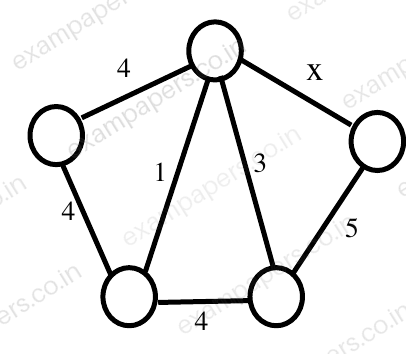
Choose a value for x that will maximize the number of minimum weight spanning trees (MWSTs) of G. The number of MWSTs of G for this value of x is _____.
Log in to check the answer
You can attempt this question now. Sign in to view the answer key, explanations and discussion.Log in to check answerQuestion 48
Open questionCSNAT2 marksNeeds review
Consider the weights and values of items listed below. Note that there is only one unit of each item.
Item number | Weight (in Kgs) | Value (in Rupees) |
|---|---|---|
1 | 10 | 60 |
2 | 7 | 28 |
3 | 4 | 20 |
4 | 2 | 24 |
The task is to pick a subset of these items such that their total weight is no more than 11 Kgs and their total value is maximized. Moreover, no item may be split. The total value of items picked by an optimal algorithm is denoted by
. A greedy algorithm sorts the items by their value-to-weight ratios in descending order and packs them greedily, starting from the first item in the ordered list. The total value of items picked by the greedy algorithm is denoted by
.The value of
is __________.Log in to check the answer
You can attempt this question now. Sign in to view the answer key, explanations and discussion.Log in to check answerQuestion 49
Open questionCSNAT2 marksNeeds review
Consider the minterm list form of a Boolean function
given below.
Here,
denotes a minterm and
denotes a don't care term. The number of essential prime implicants of the function
is _____.Log in to check the answer
You can attempt this question now. Sign in to view the answer key, explanations and discussion.Log in to check answerQuestion 50
Open questionCSNAT2 marksNeeds review
The instruction pipeline of a RISC processor has the following stages: Instruction Fetch (IF), Instruction Decode (ID), Operand Fetch (OF), Perform Operation (PO) and Writeback (WB). The IF, ID, OF and WB stages take 1 clock cycle each for every instruction. Consider a sequence of 100 instructions. In the PO stage, 40 instructions take 3 clock cycles each, 35 instructions take 2 clock cycles each, and the remaining 25 instructions take 1 clock cycle each. Assume that there are no data hazards and no control hazards.
The number of clock cycles required for completion of execution of the sequence of instructions is _____.
Log in to check the answer
You can attempt this question now. Sign in to view the answer key, explanations and discussion.Log in to check answer