
Electronics and Communication Engineering
GATE ECE year:2021 PYQs
Build your understanding with focused practice from past exam papers.
Questions 11–20 of 65. Imported answers require independent review unless marked reviewed.
Question 1
Open questionECMCQ1 markNeeds review
The vector function
is defined over a circular arc
shown in the figure.
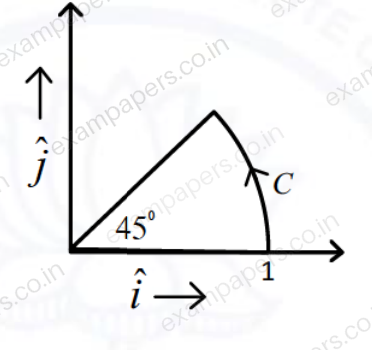
The line integral of
isYour answerChoose one option.
Log in to check the answer
You can attempt this question now. Sign in to view the answer key, explanations and discussion.Log in to check answerQuestion 2
Open questionECMCQ1 markNeeds review
Consider the differential equation given below.
The integrating factor of the differential equation isYour answerChoose one option.
Log in to check the answer
You can attempt this question now. Sign in to view the answer key, explanations and discussion.Log in to check answerQuestion 3
Open questionECMCQ1 markNeeds review
Two continuous random variables
and
are related as
Let
and
denote the variances of
and
, respectively. The variances are related asYour answerChoose one option.
Log in to check the answer
You can attempt this question now. Sign in to view the answer key, explanations and discussion.Log in to check answerQuestion 4
Open questionECMCQ1 markNeeds review
Consider a real-valued base-band signal
, band limited to 10 kHz. The Nyquist rate for the signal
isYour answerChoose one option.
Log in to check the answer
You can attempt this question now. Sign in to view the answer key, explanations and discussion.Log in to check answerQuestion 5
Open questionECMCQ1 markNeeds review
Consider two 16-point sequences
and
. Let the linear convolution of
and
be denoted by
, while
denotes the 16-point inverse discrete Fourier transform (IDFT) of the product of the 16-point discrete Fourier transforms (DFTs) of
and
. The value(s) of
for which
is/areYour answerChoose one option.
Log in to check the answer
You can attempt this question now. Sign in to view the answer key, explanations and discussion.Log in to check answerQuestion 6
Open questionECMCQ1 markNeeds review
A bar of silicon is doped with boron concentration of
and assumed to be fully ionized. It is exposed to light such that electron-hole pairs are generated throughout the volume of the bar at the rate of
. If the recombination lifetime is 100
s, intrinsic carrier concentration of silicon is
and assuming 100% ionization of boron, then the approximate product of steady-state electron and hole concentrations due to this light exposure isYour answerChoose one option.
Log in to check the answer
You can attempt this question now. Sign in to view the answer key, explanations and discussion.Log in to check answerQuestion 7
Open questionECMCQ1 markNeeds review
The energy band diagram of a p-type semiconductor bar of length L under equilibrium condition (i.e., the Fermi energy level
is constant) is shown in the figure. The valence band
is sloped since doping is non-uniform along the bar. The difference between the energy levels of the valence band at the two edges of the bar is
. 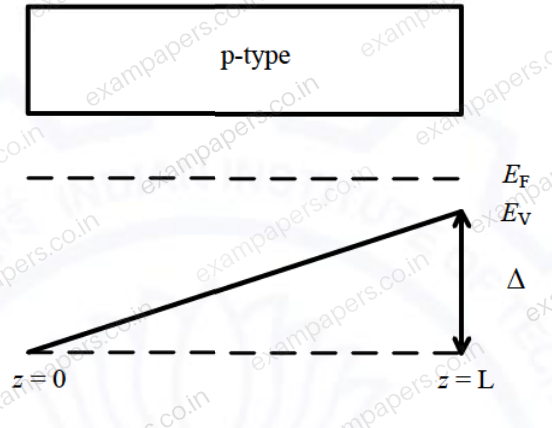
If the charge of an electron is q, then the magnitude of the electric field developed inside this semiconductor bar is
Your answerChoose one option.
Log in to check the answer
You can attempt this question now. Sign in to view the answer key, explanations and discussion.Log in to check answerQuestion 8
Open questionECMCQ1 markNeeds review
In the circuit shown in the figure, the transistors
and
are operating in saturation. The channel length modulation coefficients of both the transistors are non-zero. The transconductance of the MOSFETs
and
are
and
, respectively, and the internal resistance of the MOSFETs
and
are
and
, respectively. 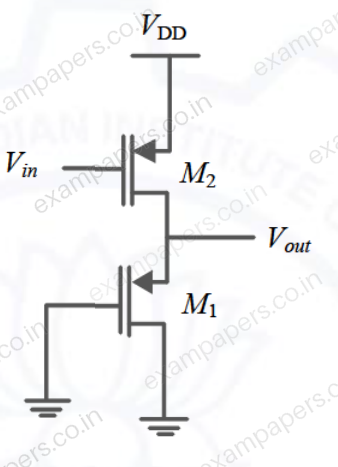
Ignoring the body effect, the ac small signal voltage gain (
) of the circuit isYour answerChoose one option.
Log in to check the answer
You can attempt this question now. Sign in to view the answer key, explanations and discussion.Log in to check answerQuestion 9
Open questionECMCQ1 markNeeds review
For the circuit with an ideal OPAMP shown in the figure,
is fixed. 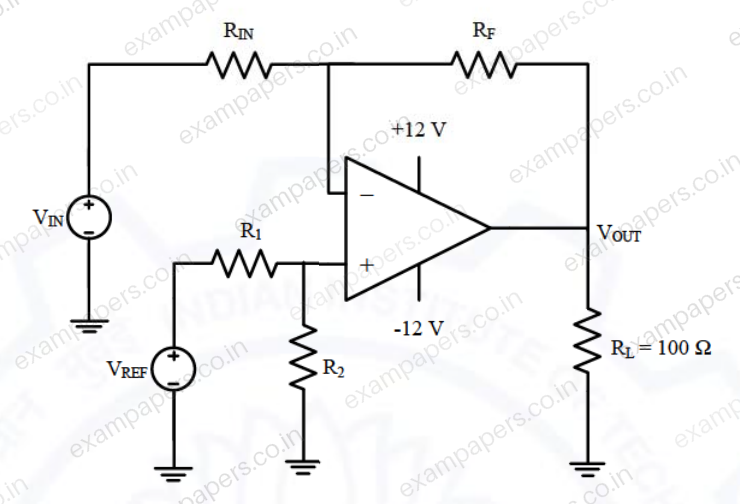
If
volt for
volt and
volt for
volt, where
is measured across
connected at the output of this OPAMP, the value of
isYour answerChoose one option.
Log in to check the answer
You can attempt this question now. Sign in to view the answer key, explanations and discussion.Log in to check answerQuestion 10
Open questionECMCQ1 markNeeds review
Consider the circuit with an ideal OPAMP shown in the figure. Assuming
and
, the condition at which
equals to zero is 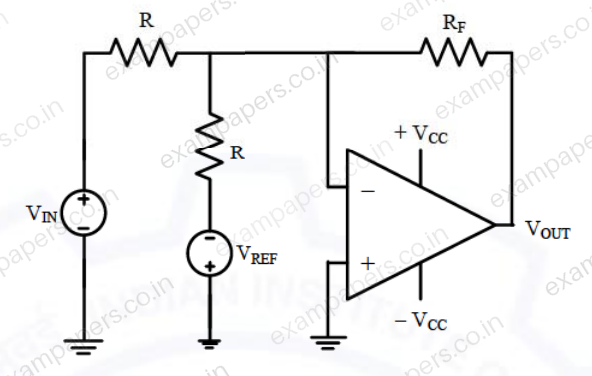
Your answerChoose one option.
Log in to check the answer
You can attempt this question now. Sign in to view the answer key, explanations and discussion.Log in to check answer