
Environmental Science and Engineering
GATE ES format:mcq PYQs
Build your understanding with focused practice from past exam papers.
Questions 51–60 of 200. Imported answers require independent review unless marked reviewed.
Question 18
Open questionESMCQ1 markNeeds review
Match the following and choose the correct option from the following
Type of reactor | Diagram |
|---|---|
1. Plug flow reactor | x.  |
2. Continuously stirred tank reactor | y.  |
3. Batch reactor | z.  |
The stirrer symbol indicates stirrer for mixing (not to scale).
Your answerChoose one option.
Log in to check the answer
You can attempt this question now. Sign in to view the answer key, explanations and discussion.Log in to check answerQuestion 19
Open questionESMCQ1 markNeeds review
Multiple effect evaporator is commonly used, in the zero liquid discharge (ZLD) scheme, for ________
Your answerChoose one option.
Log in to check the answer
You can attempt this question now. Sign in to view the answer key, explanations and discussion.Log in to check answerQuestion 20
Open questionESMCQ1 markNeeds review
Consider the following statements
P : According to the National Ambient Air Quality Standards (Central Pollution Control Board, Govt. of India, notification 2009), annual time weighted average PM₁₀ standard is more than PM₂.₅ standard.
Q : According to the National Air Quality Index released by Govt. of India in 2015, sub index value of PM₁₀ can be less than that of PM₂.₅.
Choose the correct option from the following
Your answerChoose one option.
Log in to check the answer
You can attempt this question now. Sign in to view the answer key, explanations and discussion.Log in to check answerQuestion 21
Open questionESMCQ1 markNeeds review
Which option gives the components that are most likely to be present in the segregated combustible fraction (SCF) separated from raw mixed municipal solid waste (MSW)?
Your answerChoose one option.
Log in to check the answer
You can attempt this question now. Sign in to view the answer key, explanations and discussion.Log in to check answerQuestion 22
Open questionESMCQ1 markNeeds review
Correctly match the sustainable development goal (SDG) with its theme
SDG | Theme |
|---|---|
i. SDG 6 | p. Good Health and Well-being |
ii. SDG 11 | q. Responsible Consumption and Production |
iii. SDG 3 | r. Sustainable Cities and Communities |
iv. SDG 12 | s. Clean Water and Sanitation |
Your answerChoose one option.
Log in to check the answer
You can attempt this question now. Sign in to view the answer key, explanations and discussion.Log in to check answerQuestion 23
Open questionESMCQ1 markNeeds review
Choose the correct option regarding the Basel Convention
Your answerChoose one option.
Log in to check the answer
You can attempt this question now. Sign in to view the answer key, explanations and discussion.Log in to check answerQuestion 36
Open questionESMCQ2 marksNeeds review
A researcher added certain amount of HgCl₂ to water at pH 10. He calculated the expected concentration of mercury in the water. He asked his student to measure the concentration. His student used an instrument that can measure only the free metal, Hg²⁺. The student observed that the concentration measured by him was significantly less than the concentration calculated by the researcher. How can he explain the paradox to the researcher?
Explanation 1: Significant fraction of the mercury would have changed phase from aqueous to gaseous phase, thus leaving less mercury in the water
Explanation 2: Fraction of the mercury added to water would have formed aqueous complexes
Explanation 3: Fraction of the mercury added to water could have precipitated
Choose the correct option from the following
Your answerChoose one option.
Log in to check the answer
You can attempt this question now. Sign in to view the answer key, explanations and discussion.Log in to check answerQuestion 37
Open questionESMCQ2 marksNeeds review
Correctly label the speciation diagram below:
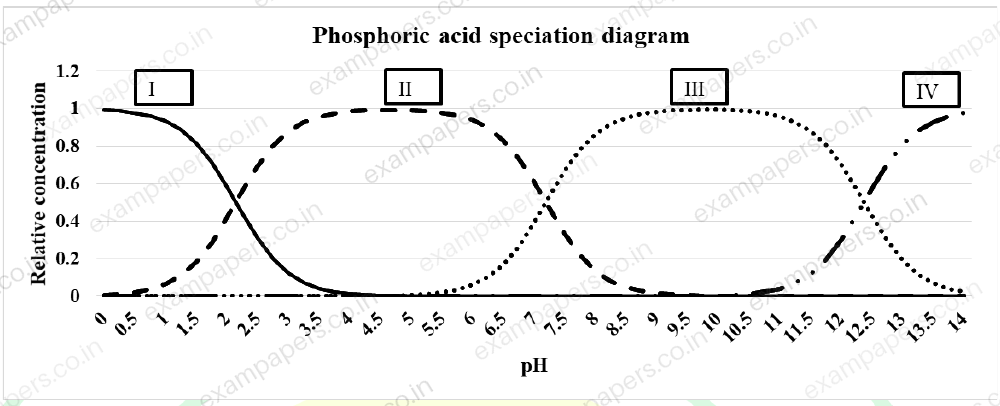
Your answerChoose one option.
Log in to check the answer
You can attempt this question now. Sign in to view the answer key, explanations and discussion.Log in to check answerQuestion 38
Open questionESMCQ2 marksNeeds review
Consider the following statements on microbial metabolism
(i) Utilization of carbon for cell synthesis is termed as anabolism.
(ii) During catabolism, adenosine triphosphate (ATP) is converted into adenosine diphosphate (ADP).
Choose the correct option from the following
Your answerChoose one option.
Log in to check the answer
You can attempt this question now. Sign in to view the answer key, explanations and discussion.Log in to check answerQuestion 39
Open questionESMCQ2 marksNeeds review
Consider the following figure of an activated sludge process (ASP), depicting the flow (
), substrate (
), and microorganism concentration (
) at various points in the system, where subscripts “0”, “r”, “w”, “e”, and “i” indicate influent, recycle line, wastage, effluent, and flow from aeration tank to settling tank, respectively. Note that influent to the ASP has microbes too. V is volume of aeration tank.

Choose the correct option for net rate of formation of microorganisms in the system at steady state, from the following
Your answerChoose one option.
Log in to check the answer
You can attempt this question now. Sign in to view the answer key, explanations and discussion.Log in to check answer