
Mechanical Engineering
GATE ME Casting, Forming and Joining Processes PYQs
Build your understanding with focused practice from past exam papers.
Questions 11–20 of 51. Imported answers require independent review unless marked reviewed.
Question 19
Open questionMEMCQ1 markNeeds review
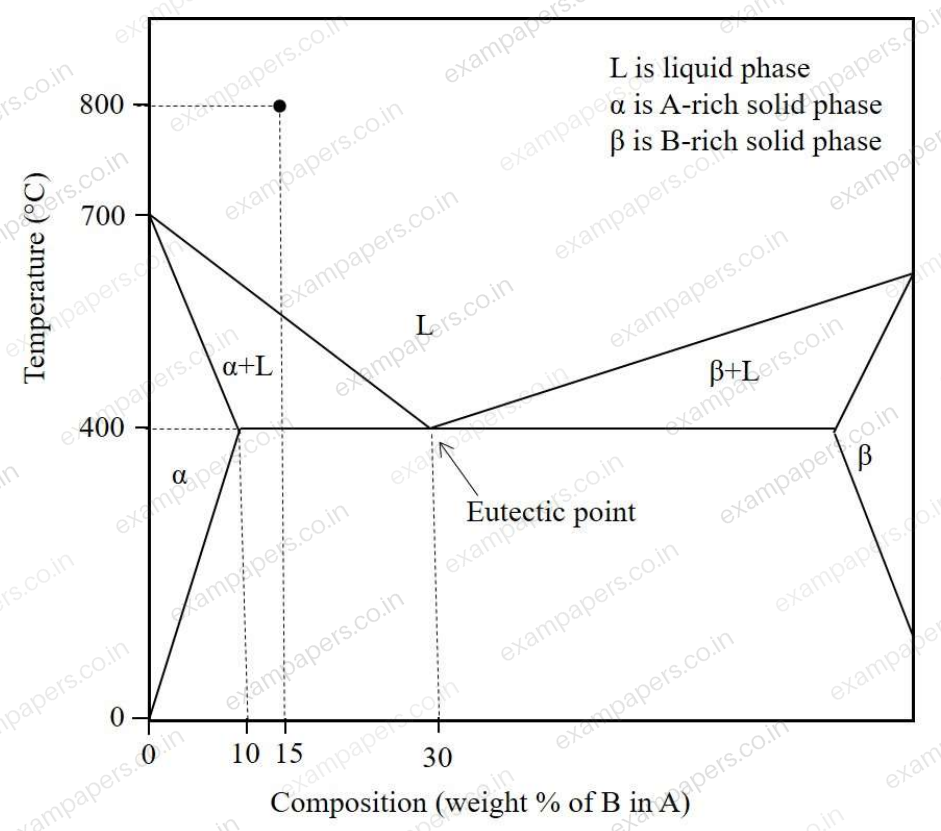
Fluidity of a molten alloy during sand casting depends on its solidification range. The phase diagram of a hypothetical binary alloy of components A and B is shown in the figure with its eutectic composition and temperature. All the lines in this phase diagram, including the solids and liquids lines, are straight lines. If this binary alloy with 15 weight % of B is poured into a mould at a pouring temperature of 800 °C, then the solidification range is
Your answerChoose one option.
Log in to check the answer
You can attempt this question now. Sign in to view the answer key, explanations and discussion.Log in to check answerQuestion 27
Open questionMEMSQ1 markNeeds review
Consider sand cast of a cube of edge length
. A cylindrical riser is placed at the top of the casting. Assume solidification time,
, where
is the volume and
is the total surface area dissipating heat. If the top of the riser is insulated, which of the following radius/radii of riser is/are acceptable?Your answerSelect all correct options. You can choose more than one.
Log in to check the answer
You can attempt this question now. Sign in to view the answer key, explanations and discussion.Log in to check answerQuestion 56
Open questionMENAT2 marksNeeds review
A 4 mm thick aluminum sheet of width
mm is rolled in a two-roll mill of roll diameter 200 mm each. The workpiece is lubricated with a mineral oil, which gives a coefficient of friction,
. The flow stress (
) of the material in MPa is
, where
is the true strain. Assuming rolling to be a plane strain deformation process, the roll separation force (
) for maximum permissible draft (thickness reduction) is ________ kN (round off to the nearest integer).Use:
where
is average flow stress,
is roll-workpiece contact length, and
is the average sheet thickness.Log in to check the answer
You can attempt this question now. Sign in to view the answer key, explanations and discussion.Log in to check answerQuestion 57
Open questionMENAT2 marksNeeds review
Two mild steel plates of similar thickness, in butt-joint configuration, are welded by gas tungsten arc weld process using the following weld parameters.
Parameter | Value |
|---|---|
Welding voltage | 20 V |
Welding current | 150 A |
Welding speed | 5 mm/s |
A filler wire of the same mild steel material having 3 mm diameter is used in this welding process. The filler wire feed rate is selected such that the final weld bead is composed of 60% volume of filler and 40% volume of plate material. The heat required to melt the mild steel material is 10 J/mm
. The heat transfer factor is 0.7 and melting factor is 0.6. The feed rate of the filler wire is ________ mm/s (round off to one decimal place).Log in to check the answer
You can attempt this question now. Sign in to view the answer key, explanations and discussion.Log in to check answerQuestion 57
Open questionMENAT2 marksNeeds review
In a direct current arc welding process, the power source has an open circuit voltage of 100 V and short circuit current of 1000 A. Assume a linear relationship between voltage and current. The arc voltage (
) varies with the arc length (
) as
, where
is in volts and
is in mm. The maximum available arc power during the process is __________ kVA (in integer).Log in to check the answer
You can attempt this question now. Sign in to view the answer key, explanations and discussion.Log in to check answerQuestion 58
Open questionMENAT2 marksNeeds review
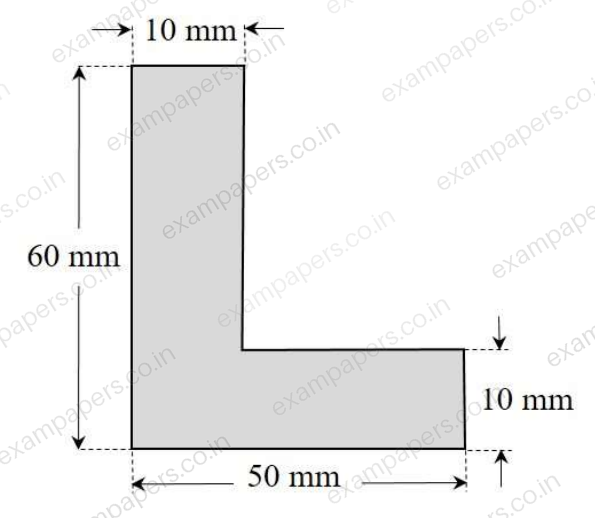
A cylindrical billet of 100 mm diameter and 100 mm length is extruded by a direct extrusion process to produce a bar of L-section. The cross sectional dimensions of this L-section bar are shown in the figure. The total extrusion pressure (
) in MPa for the above process is related to extrusion ratio (
) as
where
is the mean flow strength of the billet material in MPa,
is the portion of the billet length remaining to be extruded in mm,
is the initial diameter of the billet in mm, and
is the die shape factor.If the mean flow strength of the billet material is 50 MPa and the die shape factor is 1.05, then the maximum force required at the start of extrusion is __________ kN (round off to one decimal place).
Log in to check the answer
You can attempt this question now. Sign in to view the answer key, explanations and discussion.Log in to check answerQuestion 5
Open questionMEMCQ1 markNeeds review
The size distribution of the powder particles used in Powder Metallurgy process can be determined by
Your answerChoose one option.
Log in to check the answer
You can attempt this question now. Sign in to view the answer key, explanations and discussion.Log in to check answerQuestion 36
Open questionMENAT2 marksNeeds review
A true centrifugal casting operation needs to be performed horizontally to make copper tube sections with outer diameter of 250 mm and inner diameter of 230 mm. The value of acceleration due to gravity,
m/s
. If a G-factor (ratio of centrifugal force to weight) of 60 is used for casting the tube, the rotational speed required is ______ rpm (round off to the nearest integer).Log in to check the answer
You can attempt this question now. Sign in to view the answer key, explanations and discussion.Log in to check answerQuestion 37
Open questionMENAT2 marksNeeds review
The resistance spot welding of two 1.55 mm thick metal sheets is performed using welding current of 10000 A for 0.25 s. The contact resistance at the interface of the metal sheets is 0.0001 Ω. The volume of weld nugget formed after welding is 70 mm
. Considering the heat required to melt unit volume of metal is 12 J/mm
, the thermal efficiency of the welding process is ______ % (round off to one decimal place).Log in to check the answer
You can attempt this question now. Sign in to view the answer key, explanations and discussion.Log in to check answerQuestion 37
Open questionMENAT2 marksNeeds review
A cast product of a particular material has dimensions 75 mm × 125 mm × 20 mm. The total solidification time for the cast product is found to be 2.0 minutes as calculated using Chvorinov’s rule having the index,
= 2. If under the identical casting conditions, the cast product shape is changed to a cylinder having diameter = 50 mm and height = 50 mm, the total solidification time will be ____________ minutes (round off to two decimal places).Log in to check the answer
You can attempt this question now. Sign in to view the answer key, explanations and discussion.Log in to check answer