
Mechanical Engineering
GATE ME Inventory Control PYQs
Build your understanding with focused practice from past exam papers.
How to practice Inventory Control
Attempt a question, record the concept and assumptions, then check the available answer. Rework mistakes after revising the relevant concepts. Topic tags can overlap; review the question context.
Questions 1–10 of 12. Imported answers require independent review unless marked reviewed.
Question 61
Open questionMENAT2 marksNeeds review
The inventory holding cost of an item is ₹ 0.50 per unit per month and the ordering cost per order is ₹ 550. A stockist needs to supply 1000 units of the item per year to the customers. Assume demand is fixed and shortage cost is infinite. Using classical economic order quantity (EOQ) model, the optimal lot size is ________ units per order (rounded off to nearest integer).
Log in to check the answer
You can attempt this question now. Sign in to view the answer key, explanations and discussion.Log in to check answerQuestion 64
Open questionMENAT2 marksNeeds review
A company uses 3000 units of a part annually. The units are priced as given in the table below. It costs ₹ 150 to place an order. Carrying costs are 40 percent of the purchase price per unit on an annual basis. The optimal total annual cost is ₹ ______ (rounded off to 1 decimal place).
Order quantity | Unit price (₹) |
|---|---|
1 to 499 | 9.0 |
500 to 999 | 8.5 |
1000 or more | 8.0 |
Log in to check the answer
You can attempt this question now. Sign in to view the answer key, explanations and discussion.Log in to check answerQuestion 38
Open questionMEMCQ2 marksNeeds review
A company orders gears in conditions identical to those considered in the economic order quantity (EOQ) model in inventory control. The annual demand is 800 gears, the cost per order is 300 rupees, and the holding cost is 12 rupees per month per gear. The company uses an order size that is 25% more than the optimal order quantity determined by the EOQ model. The percentage change in the total cost of ordering and holding inventory from that associated with the optimal order quantity is
Your answerChoose one option.
Log in to check the answer
You can attempt this question now. Sign in to view the answer key, explanations and discussion.Log in to check answerQuestion 13
Open questionMEMCQ1 markNeeds review
With reference to the Economic Order Quantity (EOQ) model, which one of the options given is correct?
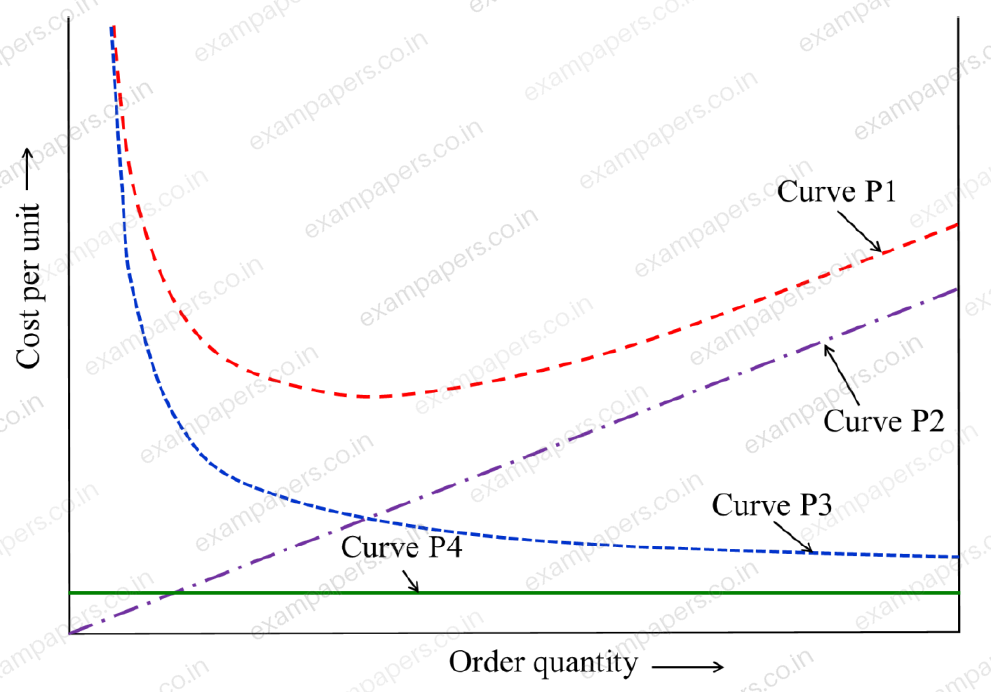
Your answerChoose one option.
Log in to check the answer
You can attempt this question now. Sign in to view the answer key, explanations and discussion.Log in to check answerQuestion 22
Open questionMEMCQ1 markNeeds review
Which one of the following is NOT a form of inventory?
Your answerChoose one option.
Log in to check the answer
You can attempt this question now. Sign in to view the answer key, explanations and discussion.Log in to check answerQuestion 33
Open questionMENAT1 markNeeds review
The demand of a certain part is 1000 parts/year and its cost is ₹100/part. The orders are placed based on the economic order quantity (EOQ). The cost of ordering is ₹100/order and the lead time for receiving the orders is 5 days. If the holding cost is ₹20/part/year, the inventory level for placing the orders is ______ parts (round off to the nearest integer).
Log in to check the answer
You can attempt this question now. Sign in to view the answer key, explanations and discussion.Log in to check answerQuestion 20
Open questionMENAT1 markNeeds review
Robot Ltd. wishes to maintain enough safety stock during the lead time period between starting a new production run and its completion such that the probability of satisfying the customer demand during the lead time period is 95%. The lead time period is 5 days and daily customer demand can be assumed to follow the Gaussian (normal) distribution with mean 50 units and a standard deviation of 10 units. Using
, where
represents the cumulative distribution function of the standard normal random variable, the amount of safety stock that must be maintained by Robot Ltd. to achieve this demand fulfilment probability for the lead time period is ______ units (round off to two decimal places).Log in to check the answer
You can attempt this question now. Sign in to view the answer key, explanations and discussion.Log in to check answerQuestion 36
Open questionMENAT2 marksNeeds review
Daily production capacity of a bearing manufacturing company is 3000 bearings. The daily demand of the bearing is 1500. The holding cost per year of keeping a bearing in the inventory is ₹ 20. The setup cost for the production of a batch is ₹ 1800. Assuming 300 working days in a year, the economic batch quantity in number of bearings is ____________ (in integer).
Log in to check the answer
You can attempt this question now. Sign in to view the answer key, explanations and discussion.Log in to check answerQuestion 47
Open questionMENAT2 marksNeeds review
For a single item inventory system, the demand is continuous, which is 1000 per year. The replenishment is instantaneous and backorders (
units) per cycle are allowed as shown in the figure.
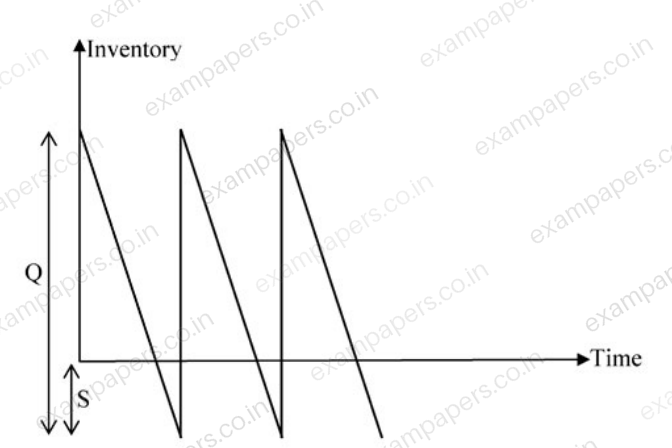
As soon as the quantity (
units) ordered from the supplier is received, the backordered quantity is issued to the customers. The ordering cost is Rs. 300 per order. The carrying cost is Rs. 4 per unit per year. The cost of backordering is Rs. 25 per unit per year. Based on the total cost minimization criteria, the maximum inventory reached in the system is ______ (round off to nearest integer).Log in to check the answer
You can attempt this question now. Sign in to view the answer key, explanations and discussion.Log in to check answerQuestion 48
Open questionMENAT2 marksNeeds review
Consider two cases as below.
Case 1: A company buys 1000 pieces per year of a certain part from vendor ‘X’. The changeover time is 2 hours and the price is Rs. 10 per piece. The holding cost rate per part is 10% per year.
Case 2: For the same part, another vendor ‘Y’ offers a design where the changeover time is 6 minutes, with a price of Rs. 5 per piece, and a holding cost rate per part of 100% per year. The order size is 800 pieces per year from ‘X’ and 200 pieces per year from ‘Y’.
Assume the cost of downtime as Rs. 20 per hour. The percentage reduction in the annual cost for Case 2, as compared to Case 1 is ______ (round off to 2 decimal places).
Log in to check the answer
You can attempt this question now. Sign in to view the answer key, explanations and discussion.Log in to check answer