
Metallurgical Engineering
GATE MT area:engineering-mathematics PYQs
Build your understanding with focused practice from past exam papers.
Questions 71–80 of 87. Imported answers require independent review unless marked reviewed.
Question 37
Open questionMTNAT2 marksNeeds review
The probability of solving a problem by Student A is (1/3), and the probability of solving the same problem by Student B is (2/5). The probability (rounded off to two decimal places) that at least one of the students solves the problem is _____________.
Log in to check the answer
You can attempt this question now. Sign in to view the answer key, explanations and discussion.Log in to check answerQuestion 38
Open questionMTNAT2 marksNeeds review
Numerical value of work done (rounded off to the nearest integer) by a position-dependent force
(where
and
are unit vectors) along the path,
, from (0,0) to (2,2) in the xy plane is _____________. 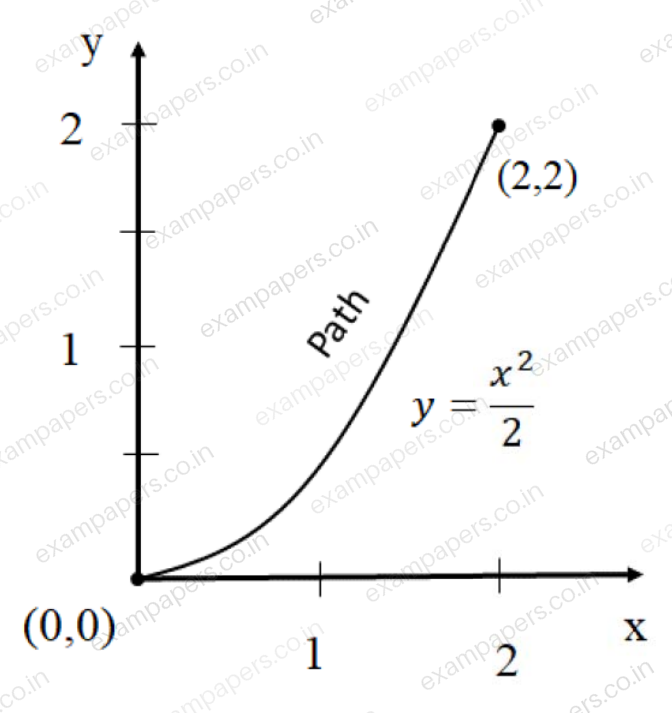
Log in to check the answer
You can attempt this question now. Sign in to view the answer key, explanations and discussion.Log in to check answerQuestion 39
Open questionMTNAT2 marksNeeds review
The estimated value of the cube root of 37 (rounded off to two decimal places) obtained from the Newton-Raphson method after two iterations (x₂) is _____________.
[Start with an initial guess value of x₀ = 1].
Log in to check the answer
You can attempt this question now. Sign in to view the answer key, explanations and discussion.Log in to check answerQuestion 41
Open questionMTNAT2 marksNeeds review
Steady state radial heat conduction through a hollow, infinitely long zirconia cylinder is governed by the following ordinary differential equation:
Here, T is the temperature and r is the radial distance. The inner surface of the hollow cylinder is maintained at 1473 K and the outer surface at 973 K. The rate of heat loss per unit length through the outer surface of the hollow cylinder (in W.m⁻¹, rounded off to the nearest integer) is _____________.
Given: Inner radius of cylinder = 0.05 m; outer radius of cylinder = 0.07 m and thermal conductivity of zirconia (k) = 2 W.m⁻¹.K⁻¹.
Log in to check the answer
You can attempt this question now. Sign in to view the answer key, explanations and discussion.Log in to check answerQuestion 3
Open questionGAMCQ1 markNeeds review
For
,
and
are both decreasing functions in the interval ______.Your answerChoose one option.
Log in to check the answer
You can attempt this question now. Sign in to view the answer key, explanations and discussion.Log in to check answerQuestion 23
Open questionMTNAT1 markNeeds review
A vector field is given as follows:
The divergence of this field evaluated at
is ______________ .Log in to check the answer
You can attempt this question now. Sign in to view the answer key, explanations and discussion.Log in to check answerQuestion 35
Open questionMTMCQ2 marksNeeds review
Consider the following Ordinary Differential Equation:
In a domain
, with boundary conditions
and
, pick the appropriate choice for
from the following options:Your answerChoose one option.
Log in to check the answer
You can attempt this question now. Sign in to view the answer key, explanations and discussion.Log in to check answerQuestion 38
Open questionMTMCQ2 marksNeeds review
A classroom of 20 students can be categorized on the basis of blood-types: 5 students each with “A”, “B”, “AB”, and “O” blood-types. If four students are selected at random from this class, what is the probability that each student has a different blood-type?
Your answerChoose one option.
Log in to check the answer
You can attempt this question now. Sign in to view the answer key, explanations and discussion.Log in to check answerQuestion 54
Open questionMTNAT2 marksNeeds review
Using the trapezoidal rule with two equal intervals (n = 2, Δx = 1), the definite integral
______________ (to two decimal places).Log in to check the answer
You can attempt this question now. Sign in to view the answer key, explanations and discussion.Log in to check answerQuestion 1
Open questionMTMCQ1 markNeeds review
For the matrix,
,
isYour answerChoose one option.
Log in to check the answer
You can attempt this question now. Sign in to view the answer key, explanations and discussion.Log in to check answer