
Metallurgical Engineering
GATE MT exam:gate PYQs
Build your understanding with focused practice from past exam papers.
Questions 531–540 of 650. Imported answers require independent review unless marked reviewed.
Question 1
Open questionMTMCQ1 markNeeds review
For a laminar flow of a liquid metal over a flat plate, the thicknesses of the velocity and thermal boundary layers are
and
respectively. Kinematic viscosity (viscosity/density) of liquid metal is significantly lower than its thermal diffusivity [thermal conductivity / (density × specific heat)]. Based on this information, pick the correct option.(Note: The temperature of the liquid metal is different from that of the plate.)
Your answerChoose one option.
Log in to check the answer
You can attempt this question now. Sign in to view the answer key, explanations and discussion.Log in to check answerQuestion 2
Open questionMTMCQ1 markNeeds review
What is the most-abundant anion in
melt?Your answerChoose one option.
Log in to check the answer
You can attempt this question now. Sign in to view the answer key, explanations and discussion.Log in to check answerQuestion 3
Open questionMTMCQ1 markNeeds review
Analysis of a flow phenomenon in a system requires the following variables:
i. Pressure [M L
T
]
ii. Velocity of the fluid [L T
]
iii. Size of the system [L]
iv. Density of the fluid [M L
]
v. Viscosity of the fluid [M L
T
]According to Buckingham Pi theorem (dimensional analysis) what is the number of independent DIMENSIONLESS variables needed to describe this system?
Your answerChoose one option.
Log in to check the answer
You can attempt this question now. Sign in to view the answer key, explanations and discussion.Log in to check answerQuestion 4
Open questionMTMCQ1 markNeeds review
In froth flotation, the primary purpose of adding collectors is to:
Your answerChoose one option.
Log in to check the answer
You can attempt this question now. Sign in to view the answer key, explanations and discussion.Log in to check answerQuestion 5
Open questionMTMCQ1 markNeeds review
Arrange the following in the correct sequence of operations in an integrated steel plant:
i. Basic Oxygen Furnace (BOF)
ii. Blast Furnace (BF)
iii. Ruhrstahl Heraeus Degasing Process (RH)
iv. Ladle Furnace Process (LF)
Your answerChoose one option.
Log in to check the answer
You can attempt this question now. Sign in to view the answer key, explanations and discussion.Log in to check answerQuestion 6
Open questionMTMCQ1 markNeeds review
During decarburization in a steel bath at 1550 °C, the compositions of dissolved C (wt.%C) and dissolved O (wt.%O) follow the relation:
(wt.%C)(wt.%O) = K
When the partial pressure of CO (
) is 1 atm, K = 0.002.
If
atm, what is the value of K, at the same temperature?
Note: Assume Henry’s law is applicable.Your answerChoose one option.
Log in to check the answer
You can attempt this question now. Sign in to view the answer key, explanations and discussion.Log in to check answerQuestion 7
Open questionMTMCQ1 markNeeds review
During upset forging, and considering friction, which of the following profiles represents the axial compressive stress?
Note: In these profiles, the absolute value of the axial compressive stress is plotted on the y-axis.
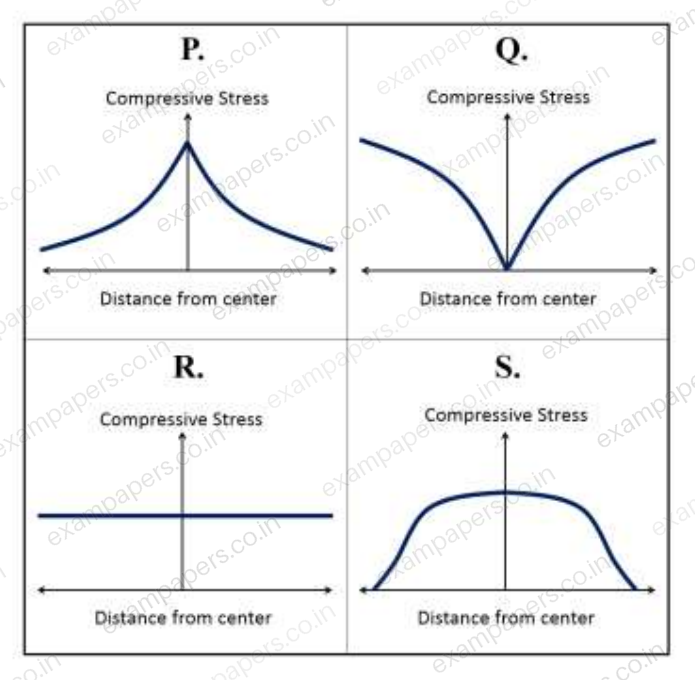
Your answerChoose one option.
Log in to check the answer
You can attempt this question now. Sign in to view the answer key, explanations and discussion.Log in to check answerQuestion 8
Open questionMTMCQ1 markNeeds review
Consider the following engineering components:
P. Gas turbine blades
Q. Tungsten-based heavy alloy penetrators
R. Self-lubricating bearings
S. Engine block of an automobile
Which of the following two components are produced by powder metallurgy?
Your answerChoose one option.
Log in to check the answer
You can attempt this question now. Sign in to view the answer key, explanations and discussion.Log in to check answerQuestion 9
Open questionMTMCQ1 markNeeds review
Which of the following materials are protected by passivation (i.e., formation of a thin adherent film on the surface) from corrosion?
P. Aluminium alloys
Q. Mild steel
R. Stainless steel
S. Silver
Your answerChoose one option.
Log in to check the answer
You can attempt this question now. Sign in to view the answer key, explanations and discussion.Log in to check answerQuestion 10
Open questionMTMCQ1 markNeeds review
The c/a ratio of Zn (hcp) is 1.856. Slip at room temperature occurs most easily on which of the following slip systems in Zn:
Note: In hcp metals, the ideal c/a ratio is 1.633.
Your answerChoose one option.
Log in to check the answer
You can attempt this question now. Sign in to view the answer key, explanations and discussion.Log in to check answer