
Metallurgical Engineering
GATE MT Heat transfer PYQs
Build your understanding with focused practice from past exam papers.
How to practice Heat transfer
Attempt a question, record the concept and assumptions, then check the available answer. Rework mistakes after revising the relevant concepts. Topic tags can overlap; review the question context.
Questions 1–10 of 13. Imported answers require independent review unless marked reviewed.
Question 27
Open questionMTMCQ1 markNeeds review
Which one of the following options is correct?
In a convective heat transfer for laminar flow over a flat plate, Nusselt number is a function of Reynolds number and Prandtl number. Similarly, in a convective mass transfer for laminar flow over a flat plate, Sherwood number is a function of:
Your answerChoose one option.
Log in to check the answer
You can attempt this question now. Sign in to view the answer key, explanations and discussion.Log in to check answerQuestion 28
Open questionMTMCQ1 markNeeds review
Which one of the following options is correct?
For a solid immersed in a fluid, the convective heat transfer coefficient across the solid-fluid interface is NOT dependent on:
Your answerChoose one option.
Log in to check the answer
You can attempt this question now. Sign in to view the answer key, explanations and discussion.Log in to check answerQuestion 59
Open questionMTNAT2 marksNeeds review
Temperatures at two sides of a 0.4 m thick copper plate are 100 and 500 °C.
Assuming steady state, one-dimensional conductive heat transfer through the wall and ignoring end-effects, the magnitude of the heat flux through the wall is _____ × 10
W m
(in integer).Given: Thermal conductivity of copper is 400 W m
K
Log in to check the answer
You can attempt this question now. Sign in to view the answer key, explanations and discussion.Log in to check answerQuestion 15
Open questionMTMCQ1 markNeeds review
As shown in the figure, two rods of different metals of equal lengths,
, diameter
(
), and constant thermal conductivities
and
(with
) are connected perfectly (i.e., zero interface thermal resistance). The left and right ends of the connected rod are maintained at temperatures
and
(
). Assume that the rods are insulated from the environment, apart from the two flat ends. Which one of the following graphs represents the temperature distribution at steady-state? The thick line shows the temperature profile. The horizontal axis shows the distance from the left end of the rod to the right and the vertical axis denotes temperature. 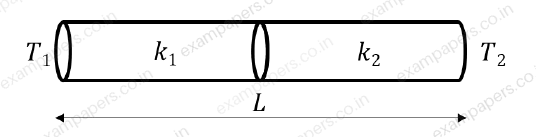
Your answerChoose one option.
Log in to check the answer
You can attempt this question now. Sign in to view the answer key, explanations and discussion.Log in to check answerQuestion 16
Open questionMTMCQ1 markNeeds review
Match the laws listed in Column I with the corresponding material properties listed in Column II
Column I
(P) Hooke’s law
(Q) Fick’s law
(R) Fourier’s law
(S) Darcy’s law
Column II
(1) Thermal conductivity
(2) Young’s modulus
(3) Permeability
(4) Diffusivity
Your answerChoose one option.
Log in to check the answer
You can attempt this question now. Sign in to view the answer key, explanations and discussion.Log in to check answerQuestion 38
Open questionMTMCQ2 marksNeeds review
As shown in the figure, the right end of a slender, long solid cylindrical metal rod of thermal conductivity
, length
and diameter
(
) is in contact with an infinite liquid heat sink. At steady-state, the temperatures of the right end of the rod and the heat sink are
and
, respectively. If the convection heat transfer coefficient between the liquid heat sink and the right end of the rod is
, then what would be the temperature of the left end of the rod,
, at steady-state? Assume that there is no other heat loss. 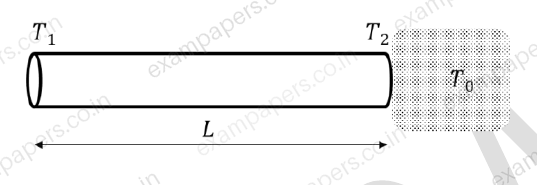
Your answerChoose one option.
Log in to check the answer
You can attempt this question now. Sign in to view the answer key, explanations and discussion.Log in to check answerQuestion 37
Open questionMTMCQ2 marksNeeds review
Match the transport processes in Column I with the relationships in Column II.
Column I
(P) Molecular momentum transport
(Q) Molecular mass transport
(R) Molecular energy transport
(S) Radiation energy transport
Column II
(1) Stefan-Boltzmann law
(2) Newton’s law of viscosity
(3) Fick’s law
(4) Fourier law
Your answerChoose one option.
Log in to check the answer
You can attempt this question now. Sign in to view the answer key, explanations and discussion.Log in to check answerQuestion 54
Open questionMTNAT2 marksNeeds review
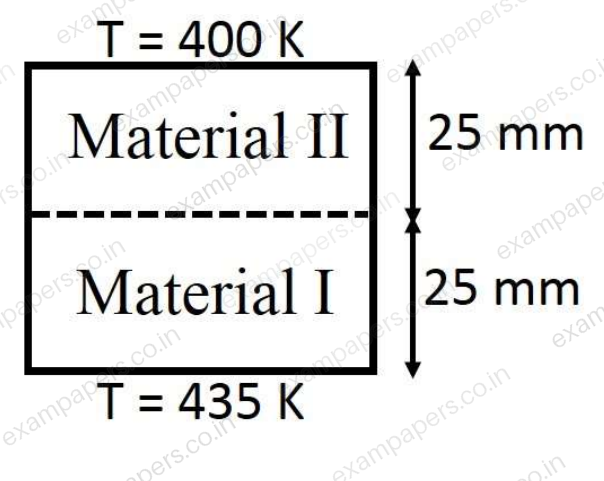
A rectangular block made of Material I and Material II of identical cross sections (as shown in the figure) has a temperature (T) of 435 K and 400 K at the bottom and top surfaces, respectively. Assuming purely steady state conductive heat transfer, the temperature at the interface is ______ K (round off to nearest integer).
(Given: The two parts of the block made of Material I and Material II have equal thickness of 25 mm each. The thermal conductivities of Material I and Material II are 50 W·m⁻¹·K⁻¹ and 200 W·m⁻¹·K⁻¹, respectively.)
Log in to check the answer
You can attempt this question now. Sign in to view the answer key, explanations and discussion.Log in to check answerQuestion 33
Open questionMTMCQ2 marksNeeds review
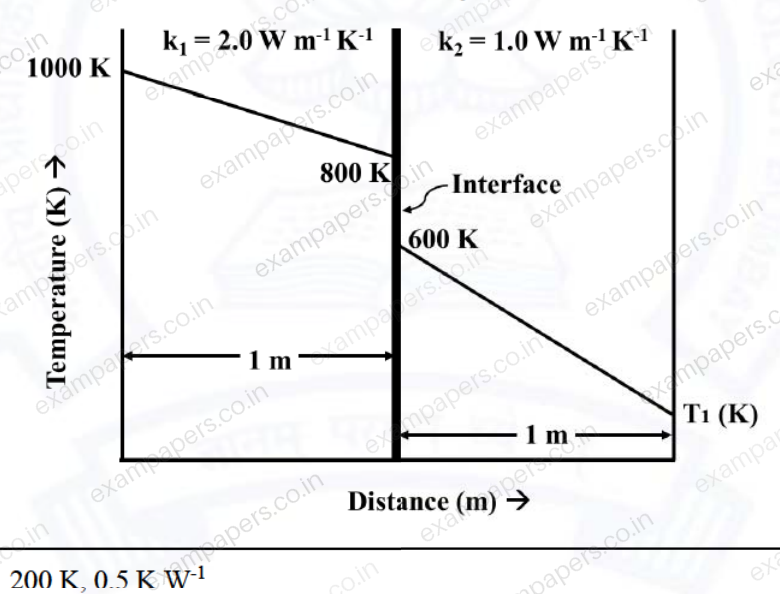
One-dimensional steady-state temperature distribution in two adjacent refractory blocks (with thermal conductivities, k₁ and k₂) of unit cross-sectional area are shown below. The temperature T₁ and thermal contact resistance of the interface, respectively, are:
Your answerChoose one option.
Log in to check the answer
You can attempt this question now. Sign in to view the answer key, explanations and discussion.Log in to check answerQuestion 11
Open questionMTMCQ1 markNeeds review
Two solid spheres X and Y of identical diameter are made of different materials having thermal diffusivities
and
respectively. Both spheres are heated in a furnace maintained at 1000 K. If the center of the sphere X reaches 800 K in 1 hour, time required for the center of sphere Y to reach 800 K isYour answerChoose one option.
Log in to check the answer
You can attempt this question now. Sign in to view the answer key, explanations and discussion.Log in to check answer