
Metallurgical Engineering
GATE MT Heat transfer PYQs
Build your understanding with focused practice from past exam papers.
Questions 11–13 of 13. Imported answers require independent review unless marked reviewed.
Question 41
Open questionMTNAT2 marksNeeds review
Steady state radial heat conduction through a hollow, infinitely long zirconia cylinder is governed by the following ordinary differential equation:
Here, T is the temperature and r is the radial distance. The inner surface of the hollow cylinder is maintained at 1473 K and the outer surface at 973 K. The rate of heat loss per unit length through the outer surface of the hollow cylinder (in W.m⁻¹, rounded off to the nearest integer) is _____________.
Given: Inner radius of cylinder = 0.05 m; outer radius of cylinder = 0.07 m and thermal conductivity of zirconia (k) = 2 W.m⁻¹.K⁻¹.
Log in to check the answer
You can attempt this question now. Sign in to view the answer key, explanations and discussion.Log in to check answerQuestion 43
Open questionMTNAT2 marksNeeds review
As shown in schematic below, an alloy is cast as a rectangular slab between two thick mould walls that differ in their thermal conductivities. Shrinkage defects are found at a distance L1 from Mould-1 with thermal conductivity
and distance L2 from Mould-2 with thermal conductivity
. If the ratio L1:L2 = 3:2, and assuming 1-D heat transfer, the ratio
is ______ (to two decimal places) 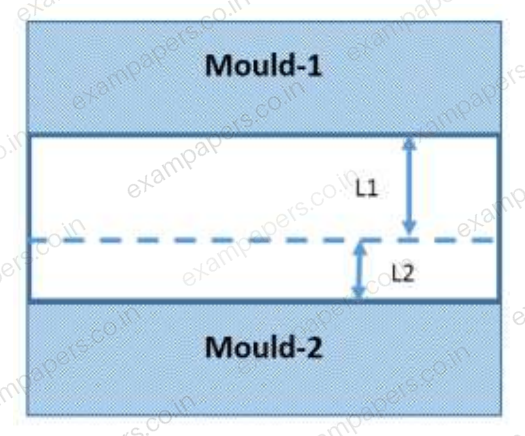
Log in to check the answer
You can attempt this question now. Sign in to view the answer key, explanations and discussion.Log in to check answerQuestion 32
Open questionMTNAT2 marksNeeds review
A continuous cast steel slab, 1 m × 1 m × 0.1 m, at 1298 K cools in air. The initial rate of heat loss (in kW) from the top surface of slab by radiation and convection is __________ (answer up to two decimal places)
Given: (i) Ambient temperature = 298 K, (ii) emissivity of steel = 0.8, (iii) convective heat transfer coefficient = 4.6 W m
K
, (iv) Stefan-Boltzmann constant (
) =
W m
K
Log in to check the answer
You can attempt this question now. Sign in to view the answer key, explanations and discussion.Log in to check answer