
Metallurgical Engineering
GATE MT topic:fatigue PYQs
Build your understanding with focused practice from past exam papers.
Questions 11–20 of 25. Imported answers require independent review unless marked reviewed.
Question 64
Open questionMTNAT2 marksNeeds review
A specimen containing maximum initial surface crack of size 1.5 mm is subjected to cyclic loading with
and
. Assuming specimen geometric factor of 1, and referring to the given figure, the crack growth rate in
m cycle
is __________ (round off to nearest integer).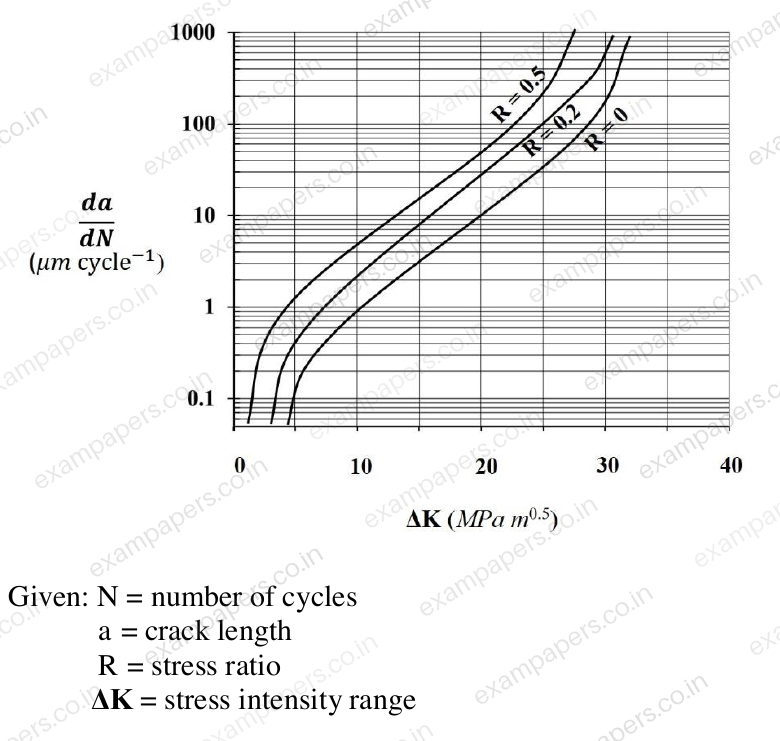
Given: N = number of cycles
a = crack length
R = stress ratio
= stress intensity rangeLog in to check the answer
You can attempt this question now. Sign in to view the answer key, explanations and discussion.Log in to check answerQuestion 32
Open questionMTMSQ1 markNeeds review
While designing a material for high temperature application, which of the following characteristic(s)/attribute(s) is(are) desirable for achieving better creep resistance?
Your answerSelect all correct options. You can choose more than one.
Log in to check the answer
You can attempt this question now. Sign in to view the answer key, explanations and discussion.Log in to check answerQuestion 41
Open questionMTMCQ2 marksNeeds review
Match the phenomena (Column I) with the descriptions (Column II)
Column I
(P) Cottrell atmosphere
(Q) Suzuki interaction
(R) Bauschinger effect
(S) Nabarro-Herring creep
Column II
(1) Decrease in yield stress when loading direction is reversed
(2) Stress assisted diffusion of vacancies resulting in plastic deformation in a polycrystalline material
(3) Lüders bands
(4) Segregation of solutes to the stacking fault
Your answerChoose one option.
Log in to check the answer
You can attempt this question now. Sign in to view the answer key, explanations and discussion.Log in to check answerQuestion 46
Open questionMTNAT2 marksNeeds review
From high temperature tensile test, the flow stress (measured at the same value of strain) of an alloy was found to be 50 MPa at a strain rate of
and 70 MPa at a strain rate of
. The strain rate sensitivity parameter is ______ (round off to 3 decimal places).Log in to check the answer
You can attempt this question now. Sign in to view the answer key, explanations and discussion.Log in to check answerQuestion 52
Open questionMTNAT2 marksNeeds review
High cycle fatigue data for an alloy at various alternating stresses,
(see figure) is given below.Stress, (MPa) | , Number of cycles to failure |
|---|---|
500 | 1000 |
400 | 10000 |
300 | 100000 |
200 | 1000000 |
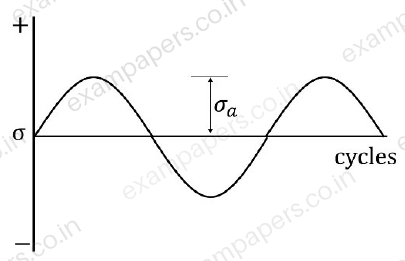 |
A specimen of this alloy is subjected to multiple stress cycles sequentially in the following order: (i) first 5000 cycles at
MPa followed by (ii) 25000 cycles at
MPa and finally (iii) at
MPa. Assuming that Miner’s law is obeyed, the number of cycles to failure at the final applied stress of 500 MPa is __________.Log in to check the answer
You can attempt this question now. Sign in to view the answer key, explanations and discussion.Log in to check answerQuestion 8
Open questionMTMCQ1 markNeeds review
Which one of the following is FALSE for creep deformation?
Your answerChoose one option.
Log in to check the answer
You can attempt this question now. Sign in to view the answer key, explanations and discussion.Log in to check answerQuestion 37
Open questionMTMCQ2 marksNeeds review
Determine the correctness or otherwise of the following Assertion [a] and the Reason [r]
Assertion [a]: Low-alloy steels used for medium-temperature creep resistance often have additions of strong carbide-forming elements.
Reason [r]: During creep deformation, the particles with higher misfit with the matrix, lose coherency.
Your answerChoose one option.
Log in to check the answer
You can attempt this question now. Sign in to view the answer key, explanations and discussion.Log in to check answerQuestion 51
Open questionMTNAT2 marksNeeds review
The steady state creep rate of a material increases by a factor of 20 when the temperature is increased from 890 K to 980 K. The creep rate at a temperature of ______ K (round off to the nearest integer) will be 5 times the creep rate at 890 K.
Log in to check the answer
You can attempt this question now. Sign in to view the answer key, explanations and discussion.Log in to check answerQuestion 52
Open questionMTNAT2 marksNeeds review
Crack growth is being continuously measured in a test specimen subjected to constant amplitude cyclic stress with a mean stress of zero. The crack growth rate is related to the stress intensity range, ΔK as
where, a is the crack length and N is the number of cycles. When the crack length increases by a factor of two, the crack growth rate will increase by a factor of ______ (round off to one decimal place).
Log in to check the answer
You can attempt this question now. Sign in to view the answer key, explanations and discussion.Log in to check answerQuestion 17
Open questionMTMCQ1 markNeeds review
In a tensile creep test of a metal, Nabarro-Herring mechanism is favored over Coble mechanism for ____________.
Your answerChoose one option.
Log in to check the answer
You can attempt this question now. Sign in to view the answer key, explanations and discussion.Log in to check answer