
Life Sciences
GATE XL branch:xl PYQs
Build your understanding with focused practice from past exam papers.
Questions 421–430 of 1235. Imported answers require independent review unless marked reviewed.
Question 55
Open questionXL-RMCQ2 marksNeeds review
Match the tasks given in Group I with the associated techniques conventionally used as listed in Group II.
Group I
P. Ploidy analysis
Q. Profiling DNA methetion
R. Identifying non-coding RNAs
S. Identifying SNPs
T. Satellite DNA isolation
Group II
RNA sequencing
Exome sequencing
Fluorescence in situ hybridization
Bisulfite sequencing
Density-gradient centrifugation
Your answerChoose one option.
Log in to check the answer
You can attempt this question now. Sign in to view the answer key, explanations and discussion.Log in to check answerQuestion 56
Open questionXL-RMCQ2 marksNeeds review
Periderm is a protective tissue found in stems and roots of gymnosperm and woody dicotyledons. It contributes to the increased thickness by secondary growth. Match the peridermal components given in Group I with the cell/tissue types given in Group II.
Group I
(P) Phelloids
(Q) Phellogen
(R) Phellem
(S) Phelloderm
Group II
(1) Tissue resembling cortical parenchyma
(2) Cork cambium
(3) Cork-like cells
(4) Cork
Your answerChoose one option.
Log in to check the answer
You can attempt this question now. Sign in to view the answer key, explanations and discussion.Log in to check answerQuestion 57
Open questionXL-RMCQ2 marksNeeds review
Match the following rice diseases in Group I with their causal agents in Group II.
Group I
(P) Blast
(Q) False smut
(R) Sheath blight
(S) Downy mildew
Group II
(1) Sclerophthora macrospora
(2) Rhizoctonia solani
(3) Ustilaginoidea virens
(4) Puccinia graminis
(5) Magnaporthe grisea
Your answerChoose one option.
Log in to check the answer
You can attempt this question now. Sign in to view the answer key, explanations and discussion.Log in to check answerQuestion 58
Open questionXL-RMCQ2 marksNeeds review
Central vascular cylinder or stele consists of the primary vascular system (xylem and phloem) and the associate fundamental tissue. Match the schematics of stele in Group I (xylem shown in green, and phloem shown as ▦) with their respective types in Group II.
Group I: (P), (Q), (R), (S), each represented by a schematic.

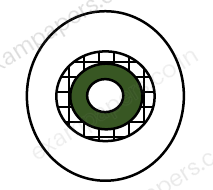
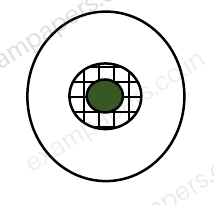
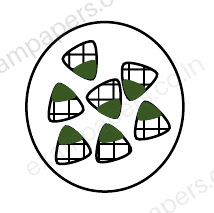
Group II
(1) Protostele
(2) Eustele
(3) Atactostele
(4) Ectophloic siphonostele
(5) Amphiphloic siphonostele
Your answerChoose one option.
Log in to check the answer
You can attempt this question now. Sign in to view the answer key, explanations and discussion.Log in to check answerQuestion 59
Open questionXL-RMCQ2 marksNeeds review
Consider the following four experimental observations (i, ii, iii, iv) on the effect of the FT gene on flowering transition in the shoot apical meristem (SAM) of Arabidopsis thaliana.
i) The FT promoter is active in leaves alone.
ii) The ft null mutation causes delayed flowering transition of the SAM.
iii) Expressing a recombinant FT protein fused to nuclear localization signal sequence under the endogenous promoter does not rescue the delayed-flowering phenotype of the ft null mutant.
iv) Downregulation of FT transcript in the SAM by RNA interference in the wild-type background does not alter flowering transition.
Which one of the following conclusions best explains the above observations?
Your answerChoose one option.
Log in to check the answer
You can attempt this question now. Sign in to view the answer key, explanations and discussion.Log in to check answerQuestion 60
Open questionXL-RMCQ2 marksNeeds review
Which one of the options given correctly matches the alkaloids in Group I with their source plants in Group II?
Group I
P. Cocaine
Q. Caffeine
R. Morphine
S. Atropine
Group II
Coca
Nightshade
Coca
Poppy
Your answerChoose one option.
Log in to check the answer
You can attempt this question now. Sign in to view the answer key, explanations and discussion.Log in to check answerQuestion 61
Open questionXL-RMSQ2 marksNeeds review
A drought tolerant rice genotype was found to be associated with a missense mutation in the gene A. Which one or more of the following experiments is/are appropriate to validate whether the mutation in A is the causal factor for drought tolerance?
Your answerSelect all correct options. You can choose more than one.
Log in to check the answer
You can attempt this question now. Sign in to view the answer key, explanations and discussion.Log in to check answerQuestion 62
Open questionXL-RMSQ2 marksNeeds review
Blue light can directly induce opening of stomata. Blue light also triggers photosynthesis in the guard cells, which indirectly induces stomatal opening. Which one or more of the following experimental approaches would test the direct effect of blue light on stomatal opening?
Your answerSelect all correct options. You can choose more than one.
Log in to check the answer
You can attempt this question now. Sign in to view the answer key, explanations and discussion.Log in to check answerQuestion 63
Open questionXL-RNAT2 marksNeeds review
In a diploid angiosperm species, flower colour is regulated by the R gene. RR and Rr genotypes produce red flowers, whereas the rr genotype produces white flowers. If two individual plants are randomly selected from a large segregating population of a genetic cross between RR and rr parents, the probability of both the plants producing red flowers is ______. (Rounded off to two decimal places)
Log in to check the answer
You can attempt this question now. Sign in to view the answer key, explanations and discussion.Log in to check answerQuestion 64
Open questionXL-RNAT2 marksNeeds review
A cytoplasmic male-sterile female plant with the restorer (nuclear) genotype rr is crossed to a male-fertile male plant with the genotype RR. Both RR and Rr can restore the fertility, whereas rr cannot. When an F1 female plant with Rr genotype was test-crossed to a male-fertile male plant with the rr genotype, the percentage of the population that is male fertile would be ______ %. (Answer in integer)
Log in to check the answer
You can attempt this question now. Sign in to view the answer key, explanations and discussion.Log in to check answer