
Life Sciences
GATE XL Ecology PYQs
Build your understanding with focused practice from past exam papers.
How to practice Ecology
Attempt a question, record the concept and assumptions, then check the available answer. Rework mistakes after revising the relevant concepts. Topic tags can overlap; review the question context.
Questions 1–10 of 10. Imported answers require independent review unless marked reviewed.
Question 85
Open questionXL-TMCQ1 markNeeds review
A researcher sets up ten large outdoor tanks, each containing the same amount of algae and the same number of guppies (herbivorous fish). In five of these tanks, she also adds gourami fish, which are predators of guppies. Tanks were covered in mesh so no new species could enter. After 2 months, the researcher counted the number of guppies and gouramis, and measured the amount of algae. She found that the amount of algae was much higher in the tanks with gourami fish compared to those without gourami fish. Which one of the following processes best explains the differences in amounts of algae between these tanks?
Your answerChoose one option.
Log in to check the answer
You can attempt this question now. Sign in to view the answer key, explanations and discussion.Log in to check answerQuestion 93
Open questionXL-TMCQ2 marksNeeds review
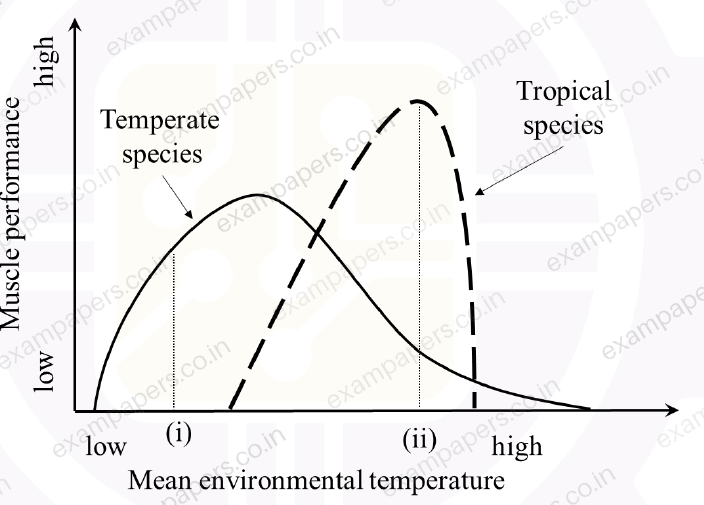
Muscle performance is positively correlated with Darwinian fitness. The graph below describes the relationship between mean environmental temperature and muscle performance for two closely related lizard species, one living in temperate areas (solid line) and another living in tropical areas (dashed line). Current mean environmental temperatures are marked with vertical dotted lines at (i) for the temperate species and (ii) for the tropical species. If mean environmental temperatures at both locations increase at a steady rate over time, which one of the following is most likely to occur in the near future?
Your answerChoose one option.
Log in to check the answer
You can attempt this question now. Sign in to view the answer key, explanations and discussion.Log in to check answerQuestion 101
Open questionXL-TMSQ2 marksNeeds review
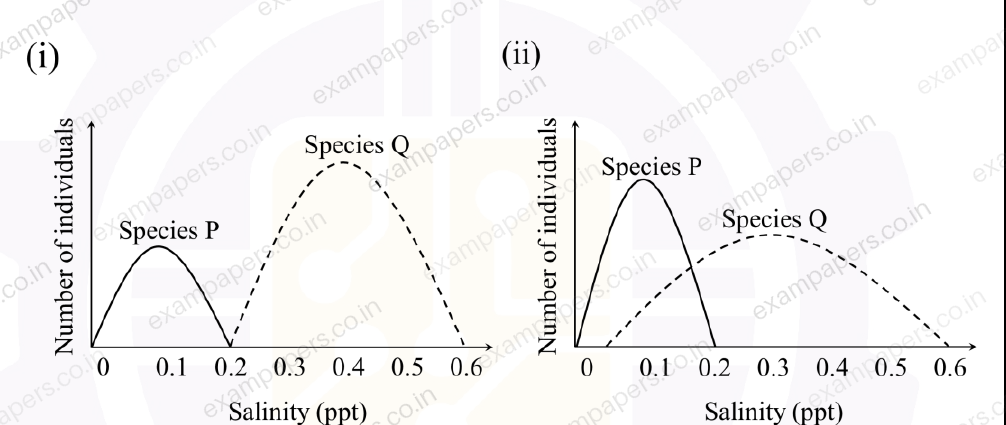
In rivers that range in salinity (ppt) from low to high, researchers find that the aquatic snail species P (solid curve) and Q (dashed curve) were distributed according to the pattern illustrated in figure (i) when the species are together. The researchers then conducted a manipulative experiment in similar rivers with the same salinity range, where they removed either species P or Q. Figure (ii) illustrates the number of individuals of species P and Q when they were allowed to live alone. These snails have no other competitors or predators. Which one or more conclusions can be drawn from these two figures?
Your answerSelect all correct options. You can choose more than one.
Log in to check the answer
You can attempt this question now. Sign in to view the answer key, explanations and discussion.Log in to check answerQuestion 99
Open questionXL-TMSQ2 marksNeeds review
Which of the following animals in India are included under “critically endangered” threat category as per the Red Data List of IUCN?
Your answerSelect all correct options. You can choose more than one.
Log in to check the answer
You can attempt this question now. Sign in to view the answer key, explanations and discussion.Log in to check answerQuestion 87
Open questionXL-TMCQ1 markNeeds review
Which one of the following represents a true “Ecological population”?
Your answerChoose one option.
Log in to check the answer
You can attempt this question now. Sign in to view the answer key, explanations and discussion.Log in to check answerQuestion 92
Open questionXL-TMSQ1 markNeeds review
Animals can be classified as ‘specialists’ or ‘generalists’ with respect to diet and habitat selection. Which of the following organism/s belong/s to the specialist category?
Your answerSelect all correct options. You can choose more than one.
Log in to check the answer
You can attempt this question now. Sign in to view the answer key, explanations and discussion.Log in to check answerQuestion 102
Open questionXL-TNAT2 marksNeeds review
A typical food chain involves producers, herbivores, primary carnivores and secondary carnivores. Based on Lindeman’s law of trophic efficiency, if producers have 40 kJ of energy, the energy that will be stored in secondary carnivores is _____ kJ. (round off to two decimal places)
Log in to check the answer
You can attempt this question now. Sign in to view the answer key, explanations and discussion.Log in to check answerQuestion 3
Open questionXL-TMCQ1 markNeeds review
Which ONE of the following is NOT a site for in situ conservation?
Your answerChoose one option.
Log in to check the answer
You can attempt this question now. Sign in to view the answer key, explanations and discussion.Log in to check answerQuestion 4
Open questionXL-TMCQ1 markNeeds review
A species adapted to a specific habitat is called
Your answerChoose one option.
Log in to check the answer
You can attempt this question now. Sign in to view the answer key, explanations and discussion.Log in to check answerQuestion 19
Open questionXL-TNAT2 marksNeeds review
A population of rabits was determined to have a birth rate of 200 and mortality rate of 50 per year. If the initial population size is 400 individuals, after 2 years of non-infered breeding the final population size will be ____________.
Log in to check the answer
You can attempt this question now. Sign in to view the answer key, explanations and discussion.Log in to check answer