
Computer Science and Information Technology
2023 · Paper 1
Take it one question at a time. Try an answer, then check your understanding.
Complete GATE CSE 2023 Paper 1 overview, original pages and practice · Timed previous-paper practice
Questions 40–42 of 65. Imported answers require review unless explicitly marked reviewed.
Question 40
Open questionCSMCQ2 marksNeeds review
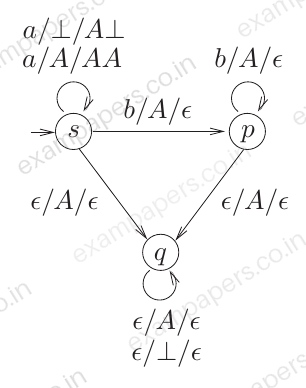
Consider the pushdown automaton (PDA)
below, which runs on the input alphabet
, has stack alphabet
, and has three states
, with
being the start state. A transition from state
to state
, labelled
, where
is an input symbol or
,
is a stack symbol, and
is a string of stack symbols, represents the fact that in state
, the PDA can read
from the input, with
on the top of its stack, pop
from the stack, push in the string
on the stack, and go to state
. In the initial configuration, the stack has only the symbol
in it. The PDA accepts by empty stack.Which one of the following options correctly describes the language accepted by
? 
Your answerChoose one option.
Log in to check the answer
You can attempt this question now. Sign in to view the answer key, explanations and discussion.Log in to check answerQuestion 41
Open questionCSMCQ2 marksNeeds review
Consider the given C-code and its corresponding assembly code, with a few operands U1–U4 being unknown. Some useful information as well as the semantics of each unique assembly instruction is annotated as inline comments in the code. The memory is byte-addressable.
//C-code ;assembly-code (; indicates comments)
;r1-r5 are 32-bit integer registers
;initialize r1=0, r2=10
;initialize r3, r4 with base address of a, b
int a[10], b[10], i; L01: jeq r1, r2, end ;if(r1==r2) goto end
// int is 32-bit L02: lw r5, 0(r4) ;r5 <- Memory[r4+0]
for (i=0; i<10; i++) L03: shl r5, r5, U1 ;r5 <- r5 << U1
a[i] = b[i] * 8; L04: sw r5, 0(r3) ;Memory[r3+0] <- r5
L05: add r3, r3, U2 ;r3 <- r3+U2
L06: add r4, r4, U3
L07: add r1, r1, 1
L08: jmp U4 ;goto U4
L09: end
Which one of the following options is a CORRECT replacement for operands in the position (U1, U2, U3, U4) in the above assembly code?
Your answerChoose one option.
Log in to check the answer
You can attempt this question now. Sign in to view the answer key, explanations and discussion.Log in to check answerQuestion 42
Open questionCSMCQ2 marksNeeds review
A 4 kilobyte (KB) byte-addressable memory is realized using four 1 KB memory blocks. Two input address lines (IA4 and IA3) are connected to the chip select (CS) port of these memory blocks through a decoder as shown in the figure. The remaining ten input address lines from IA11–IA0 are connected to the address port of these blocks. The chip select (CS) is active high.
The input memory address (IA11–IA0), in decimal, for the starting locations (Addr=0) of each block (indicated as X1, X2, X3, X4 in the figure are among the options given below. Which one of the following options is CORRECT?
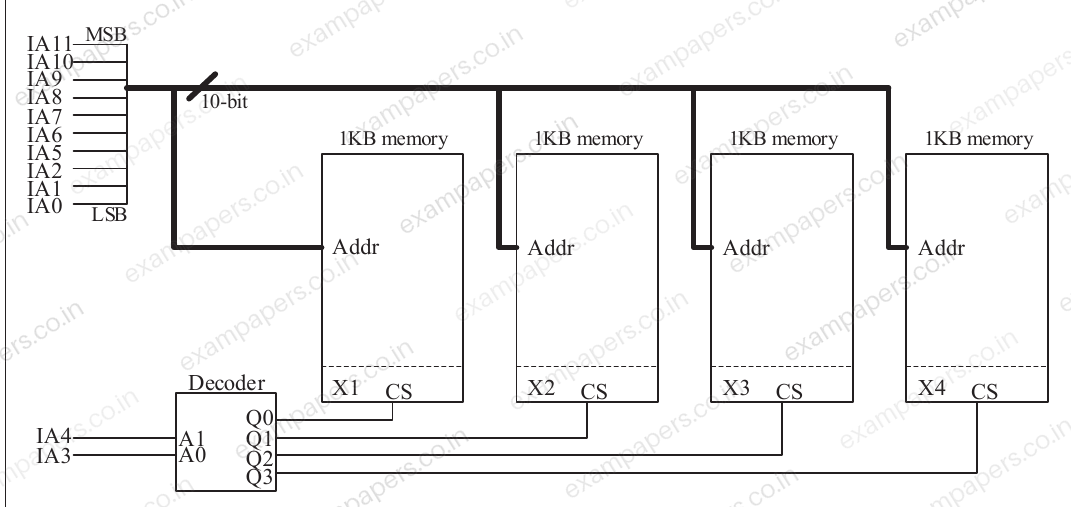
Your answerChoose one option.
Log in to check the answer
You can attempt this question now. Sign in to view the answer key, explanations and discussion.Log in to check answer