
Computer Science and Information Technology
GATE CSE format:mcq PYQs
Build your understanding with focused practice from past exam papers.
Questions 211–220 of 534. Imported answers require independent review unless marked reviewed.
Question 39
Open questionCSMCQ2 marksNeeds review
Consider the context-free grammar
below
where
and
are non-terminals, and
and
are terminal symbols. The starting non-terminal is
.Which one of the following statements is CORRECT?
Your answerChoose one option.
Log in to check the answer
You can attempt this question now. Sign in to view the answer key, explanations and discussion.Log in to check answerQuestion 40
Open questionCSMCQ2 marksNeeds review
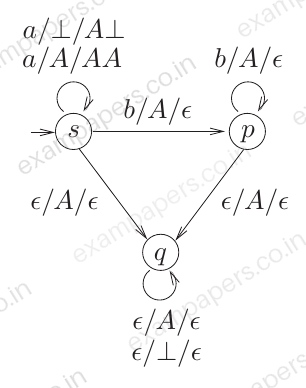
Consider the pushdown automaton (PDA)
below, which runs on the input alphabet
, has stack alphabet
, and has three states
, with
being the start state. A transition from state
to state
, labelled
, where
is an input symbol or
,
is a stack symbol, and
is a string of stack symbols, represents the fact that in state
, the PDA can read
from the input, with
on the top of its stack, pop
from the stack, push in the string
on the stack, and go to state
. In the initial configuration, the stack has only the symbol
in it. The PDA accepts by empty stack.Which one of the following options correctly describes the language accepted by
? 
Your answerChoose one option.
Log in to check the answer
You can attempt this question now. Sign in to view the answer key, explanations and discussion.Log in to check answerQuestion 41
Open questionCSMCQ2 marksNeeds review
Consider the given C-code and its corresponding assembly code, with a few operands U1–U4 being unknown. Some useful information as well as the semantics of each unique assembly instruction is annotated as inline comments in the code. The memory is byte-addressable.
//C-code ;assembly-code (; indicates comments)
;r1-r5 are 32-bit integer registers
;initialize r1=0, r2=10
;initialize r3, r4 with base address of a, b
int a[10], b[10], i; L01: jeq r1, r2, end ;if(r1==r2) goto end
// int is 32-bit L02: lw r5, 0(r4) ;r5 <- Memory[r4+0]
for (i=0; i<10; i++) L03: shl r5, r5, U1 ;r5 <- r5 << U1
a[i] = b[i] * 8; L04: sw r5, 0(r3) ;Memory[r3+0] <- r5
L05: add r3, r3, U2 ;r3 <- r3+U2
L06: add r4, r4, U3
L07: add r1, r1, 1
L08: jmp U4 ;goto U4
L09: end
Which one of the following options is a CORRECT replacement for operands in the position (U1, U2, U3, U4) in the above assembly code?
Your answerChoose one option.
Log in to check the answer
You can attempt this question now. Sign in to view the answer key, explanations and discussion.Log in to check answerQuestion 42
Open questionCSMCQ2 marksNeeds review
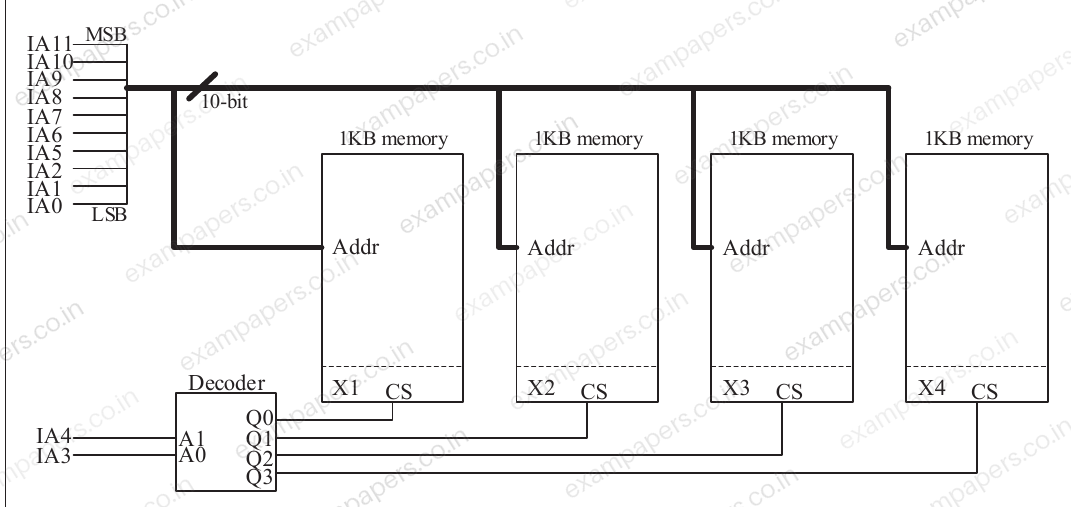
A 4 kilobyte (KB) byte-addressable memory is realized using four 1 KB memory blocks. Two input address lines (IA4 and IA3) are connected to the chip select (CS) port of these memory blocks through a decoder as shown in the figure. The remaining ten input address lines from IA11–IA0 are connected to the address port of these blocks. The chip select (CS) is active high.
The input memory address (IA11–IA0), in decimal, for the starting locations (Addr=0) of each block (indicated as X1, X2, X3, X4 in the figure are among the options given below. Which one of the following options is CORRECT?
Your answerChoose one option.
Log in to check the answer
You can attempt this question now. Sign in to view the answer key, explanations and discussion.Log in to check answerQuestion 43
Open questionCSMCQ2 marksNeeds review
Consider a sequential digital circuit consisting of T flip-flops and D flip-flops as shown in the figure. CLKIN is the clock input to the circuit. At the beginning, Q1, Q2 and Q3 have values 0, 1 and 1, respectively.
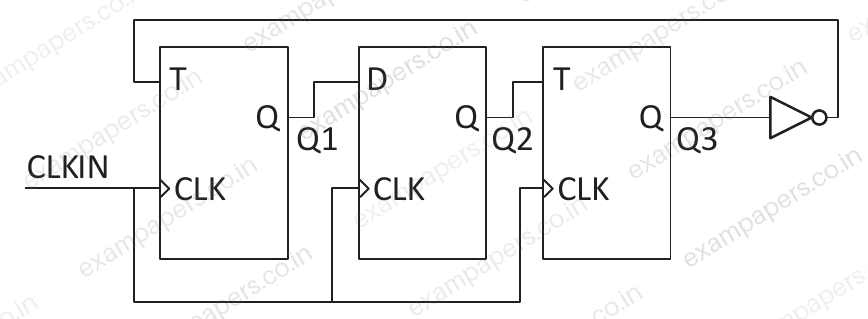
Which one of the given values of (Q1, Q2, Q3) can NEVER be obtained with this digital circuit?
Your answerChoose one option.
Log in to check the answer
You can attempt this question now. Sign in to view the answer key, explanations and discussion.Log in to check answerQuestion 44
Open questionCSMCQ2 marksNeeds review
A Boolean digital circuit is composed using two 4-input multiplexers (M1 and M2) and one 2-input multiplexer (M3) as shown in the figure. X0–X7 are the inputs of the multiplexers M1 and M2 and could be connected to either 0 or 1. The select lines of the multiplexers are connected to Boolean variables A, B and C as shown.
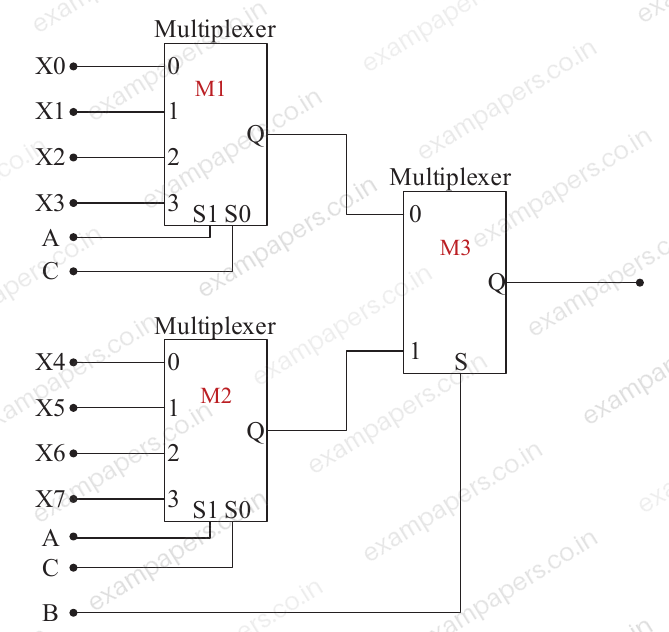
Which one of the following sets of values of (X0, X1, X2, X3, X4, X5, X6, X7) will realise the Boolean function
?Your answerChoose one option.
Log in to check the answer
You can attempt this question now. Sign in to view the answer key, explanations and discussion.Log in to check answerQuestion 45
Open questionCSMCQ2 marksNeeds review
Consider the IEEE-754 single precision float point numbers P=0xC1800000 and Q=0x3F5C2EF4.
Which one of the following corresponds to the product of these numbers (i.e., P × Q), represented in the IEEE-754 single precision format?
Your answerChoose one option.
Log in to check the answer
You can attempt this question now. Sign in to view the answer key, explanations and discussion.Log in to check answerQuestion 46
Open questionCSMCQ2 marksNeeds review
Let A be a priority queue for maintaining a set of elements. Suppose A is implemented using a max-heap data structure. The operation Extract-Max(A) extracts and deletes the maximum element from A. The operation Insert(A,key) inserts a new element key in A. The properties of a max-heap are preserved at the end of each of these operations.
When A contains n elements, which one of the following statements about the worst case running time of these two operations is TRUE?
Your answerChoose one option.
Log in to check the answer
You can attempt this question now. Sign in to view the answer key, explanations and discussion.Log in to check answerQuestion 47
Open questionCSMCQ2 marksNeeds review
Consider the C function foo and the binary tree shown.
typedef struct node {
int val;
struct node *left, *right;
} node;
int foo(node *p) {
int retval;
if (p == NULL)
return 0;
else {
retval = p->val + foo(p->left) + foo(p->right);
printf("%d ", retval);
return retval;
}
}
When foo is called with a pointer to the root node of the given binary tree, what will it print?
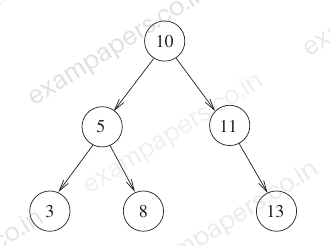
Your answerChoose one option.
Log in to check the answer
You can attempt this question now. Sign in to view the answer key, explanations and discussion.Log in to check answerQuestion 48
Open questionCSMCQ2 marksNeeds review
Let
, where
is a large positive integer greater than 100. Let
be a positive integer less than
. Let
be subsets of
with
and
. We say that a permutation of
separates
from
if one of the following is true.All members of
appear in the permutation before any of the members of
.All members of
appear in the permutation before any of the members of
.How many permutations of
separate
from
?Your answerChoose one option.
Log in to check the answer
You can attempt this question now. Sign in to view the answer key, explanations and discussion.Log in to check answer