
Computer Science and Information Technology
GATE CSE year:2020 PYQs
Build your understanding with focused practice from past exam papers.
Questions 11–20 of 65. Imported answers require independent review unless marked reviewed.
Question 1
Open questionCSMCQ1 markNeeds review
Consider the functions
I.
II.
III.
Which of the above functions is/are increasing everywhere in [0,1]?
Your answerChoose one option.
Log in to check the answer
You can attempt this question now. Sign in to view the answer key, explanations and discussion.Log in to check answerQuestion 2
Open questionCSMCQ1 markNeeds review
For parameters
and
, both of which are
,
, and
.Then
isYour answerChoose one option.
Log in to check the answer
You can attempt this question now. Sign in to view the answer key, explanations and discussion.Log in to check answerQuestion 3
Open questionCSMCQ1 markNeeds review
Consider the following statements.
I. Daisy chaining is used to assign priorities in attending interrupts.
II. When a device raises a vectored interrupt, the CPU does polling to identify the source of interrupt.
III. In polling, the CPU periodically checks the status bits to know if any device needs its attention.
IV. During DMA, both the CPU and DMA controller can be bus masters at the same time.
Which of the above statements is/are TRUE?
Your answerChoose one option.
Log in to check the answer
You can attempt this question now. Sign in to view the answer key, explanations and discussion.Log in to check answerQuestion 4
Open questionCSMCQ1 markNeeds review
Consider the following data path diagram.
Consider an instruction: R0 ← R1 + R2. The following steps are used to execute it over the given data path. Assume that PC is incremented appropriately. The subscripts r and w indicate read and write operations, respectively.
R2ᵣ, TEMP1ᵣ, ALUₐdd, TEMP2w
R1ᵣ, TEMP1w
PCᵣ, MARw, MEMᵣ
TEMP2ᵣ, R0w
MDRᵣ, IRw
Which one of the following is the correct order of execution of the above steps?
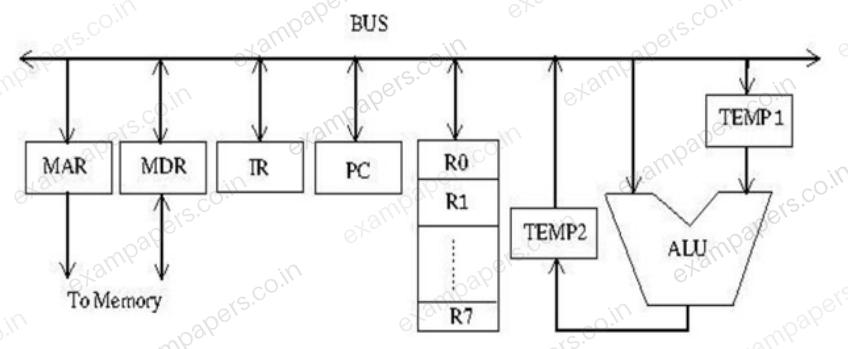
Your answerChoose one option.
Log in to check the answer
You can attempt this question now. Sign in to view the answer key, explanations and discussion.Log in to check answerQuestion 5
Open questionCSMCQ1 markNeeds review
The preorder traversal of a binary search tree is 15, 10, 12, 11, 20, 18, 16, 19.
Which one of the following is the postorder traversal of the tree?
Your answerChoose one option.
Log in to check the answer
You can attempt this question now. Sign in to view the answer key, explanations and discussion.Log in to check answerQuestion 6
Open questionCSMCQ1 markNeeds review
What is the worst case time complexity of inserting
elements into an AVL-tree with
elements initially?Your answerChoose one option.
Log in to check the answer
You can attempt this question now. Sign in to view the answer key, explanations and discussion.Log in to check answerQuestion 7
Open questionCSMCQ1 markNeeds review
Which one of the following regular expressions represents the set of all binary strings with an odd number of 1’s?
Your answerChoose one option.
Log in to check the answer
You can attempt this question now. Sign in to view the answer key, explanations and discussion.Log in to check answerQuestion 8
Open questionCSMCQ1 markNeeds review
Consider the following statements.
I. If
is regular, then both
and
must be regular.II. The class of regular languages is closed under infinite union.
Which of the above statements is/are TRUE?
Your answerChoose one option.
Log in to check the answer
You can attempt this question now. Sign in to view the answer key, explanations and discussion.Log in to check answerQuestion 9
Open questionCSMCQ1 markNeeds review
Consider the following statements.
I. Symbol table is accessed only during lexical analysis and syntax analysis.
II. Compilers for programming languages that support recursion necessarily need heap storage for memory allocation in the run-time environment.
III. Errors violating the condition ‘any variable must be declared before its use’ are detected during syntax analysis.
Which of the above statements is/are TRUE?
Your answerChoose one option.
Log in to check the answer
You can attempt this question now. Sign in to view the answer key, explanations and discussion.Log in to check answerQuestion 10
Open questionCSMCQ1 markNeeds review
Consider the language
and the following statements.I.
is deterministic context-free.II.
is context-free but not deterministic context-free.III.
is not LL(k) for any
.Which of the above statements is/are TRUE?
Your answerChoose one option.
Log in to check the answer
You can attempt this question now. Sign in to view the answer key, explanations and discussion.Log in to check answer