
Engineering Sciences
GATE XE year:2025 PYQs
Build your understanding with focused practice from past exam papers.
Questions 51–60 of 175. Imported answers require independent review unless marked reviewed.
Question 51
Open questionXE-CNAT1 markNeeds review
If solid tin is in equilibrium with its vapor, the degree of freedom is (answer in integer) __________
Log in to check the answer
You can attempt this question now. Sign in to view the answer key, explanations and discussion.Log in to check answerQuestion 52
Open questionXE-CNAT1 markNeeds review
A GaP–GaAs semiconductor LED display has a band gap of 1.9 eV. The wavelength of emitted light in
m is (round off to two decimal places) __________Given: Planck’s constant = 6.63 × 10
J s
Velocity of light = 3 × 10
m s
1 eV = 1.6 × 10
JLog in to check the answer
You can attempt this question now. Sign in to view the answer key, explanations and discussion.Log in to check answerQuestion 53
Open questionXE-CMCQ2 marksNeeds review
In an FCC crystal with lattice parameter a, consider the reaction of two leading partial dislocations, AB and CD, at the line of intersection of their slip planes (111) and (11̄1), respectively, as shown in the figure below. Dislocations, AB and CD, have Burgers vectors
and
, respectively, as given in the figure. Which one of the following options for the slip plane and the Burgers vector of the resulting dislocation is correct? 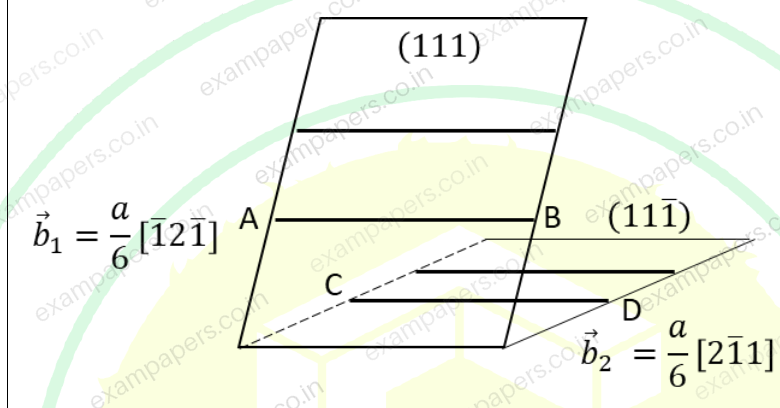
Your answerChoose one option.
Log in to check the answer
You can attempt this question now. Sign in to view the answer key, explanations and discussion.Log in to check answerQuestion 54
Open questionXE-CMCQ2 marksNeeds review
Match the detector for a scanning electron microscope (SEM) in Column I with the resulting output in Column II.
SE: Secondary electrons; BSE: Backscattered electrons;
EDS: Energy Dispersive Spectroscopy; EBSD: Electron Backscatter Diffraction
Column I
(P) SE Detector
(Q) BSE Detector
(R) EDS Detector
(S) EBSD Detector
Column II
(1) Elemental composition analysis
(2) Kikuchi lines
(3) Topographic image
(4) Compositional contrast image
Your answerChoose one option.
Log in to check the answer
You can attempt this question now. Sign in to view the answer key, explanations and discussion.Log in to check answerQuestion 55
Open questionXE-CMCQ2 marksNeeds review
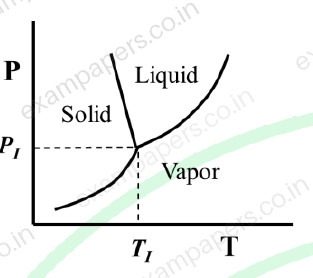
The triple point
is shown in a schematic phase diagram (pressure (P) – temperature (T) plot) for one component system.
,
and
are the free energies of solid, liquid and vapor, respectively. At a constant pressure,
, the correct free energy (G) versus temperature (T) plot is
Your answerChoose one option.
Log in to check the answer
You can attempt this question now. Sign in to view the answer key, explanations and discussion.Log in to check answerQuestion 56
Open questionXE-CMCQ2 marksNeeds review
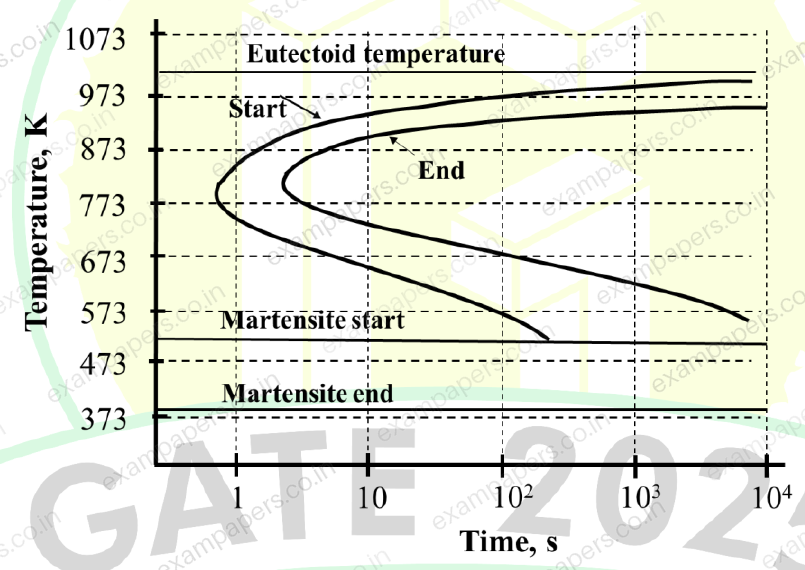
The TTT diagram for eutectoid steel is shown below. The steel after complete austenitization at 1073 K is rapidly cooled to different temperatures and held for varying times (as indicated in Column I) followed by quenching to 300 K. Assuming isothermal transformation, match the heat treatment conditions in Column I with the corresponding microstructure in Column II.
Column I Column II
(P) Held at 300 K indefinitely (1) Bainite
(Q) Held at 873 K for 4 minutes (2) Martensite
(R) Held at 673 K for 20 minutes (3) Pearlite
(S) Held at 623 K for 2 minutes (4) Bainite + Martensite
Your answerChoose one option.
Log in to check the answer
You can attempt this question now. Sign in to view the answer key, explanations and discussion.Log in to check answerQuestion 57
Open questionXE-CNAT2 marksNeeds review
A diffraction pattern is obtained from a powdered sample of a pure element, which has FCC crystal structure. If x and y are the Brag angles of the first and the third peaks, respectively, then the ratio,
, is (rounded off to one decimal place) ____________Log in to check the answer
You can attempt this question now. Sign in to view the answer key, explanations and discussion.Log in to check answerQuestion 58
Open questionXE-CNAT2 marksNeeds review
For a pure element with a BCC crystal structure, the surface energies per unit area of and free surfaces are
and
, respectively. The ratio,
, is (rounded off to one decimal place) ____________Log in to check the answer
You can attempt this question now. Sign in to view the answer key, explanations and discussion.Log in to check answerQuestion 59
Open questionXE-CNAT2 marksNeeds review
On applying 10 V across the two ends of a 100 cm long copper wire, the average drift velocity (in cm s
) in the wire is (rounded off to two decimal places) __________Given: Electron density of copper =
cm
Copper resistivity =
cmElectron charge =
CLog in to check the answer
You can attempt this question now. Sign in to view the answer key, explanations and discussion.Log in to check answerQuestion 60
Open questionXE-CNAT2 marksNeeds review
An aluminum transmission line of 7 km length is designed to carry 100 A current with no more than 2 MW power loss. The required minimum diameter (in mm) of the transmission line is (rounded to two decimal places) ____________
Given: Aluminum conductivity =
cm
Log in to check the answer
You can attempt this question now. Sign in to view the answer key, explanations and discussion.Log in to check answer